I've been hearing for a couple of years now that the retirement of Speight Jenkins, the (mostly) beloved and longtime leader of Seattle Opera was "around the corner."
Today, that retirement has finally been announced, as well as Jenkins's replacement Aidan Lang, who was found after a hush-hush, two-year search process:
Aidan Lang, respected in the opera community for positions of leadership with New Zealand Opera, Glyndebourne Opera Festival, the Buxton Festival and Opera Zuid, has been named Seattle Opera’s third General Director effective September 1, 2014. Lang succeeds Speight Jenkins, who has led the company for more than three decades. Founded in 1963, Seattle Opera celebrates its 50th Anniversary beginning with the August 2013 production of Wagner’s Ring and culminating with the 2014 International Wagner Competition and 50th Anniversary Concert and Speight Celebration in August 2014.
This announcement marks a moment in Seattle's broader culture as well. Over the past six years or so, Seattle's other two classic performing-arts organizations (the ballet and the symphony) have transitioned away from longtime leaders (Kent Stowell/Francia Russell and Gerard Schwarz) who were intensely focused on institution-building, establishing a foothold for their medium in the city's consciousness, and congealing a reliable audience and donor cohort.
The ballet replaced Stowell/Russell with Peter Boal and the symphony replaced Schwarz with Ludovic Merlot, both exciting choices for audiences in Seattle (and beyond) who were more than ready to see those sometimes staid-seeming institutions push forward into a more daring and engaged phase of their aesthetic development.
Will the 57 year-old Lang inspire the same excitement among opera geeks? Either way, the transition seems to have been meticulously choreographed.
Some of Lang bona fides from Seattle Opera's announcement are below the jump. And you can follow him on Twitter. His most recent tweet: "Speighters gonna Speight."*
This is what was going on when I rolled up around 7:45 pm.

I'd heard there was an installation that started at 7:30 pm but I assumed that it was a static installation that lasted half an hour, before the 8 pm showing of Northwest New Works. I hadn't realized the installation was a performance. There were guys coated in saw dust, women with wooden cubes entirely concealing their heads (not pictured), and other elements I only dimly perceived because I got there late and at first couldn't separate the crowd and passersby from the performers—elements including a man on a street corner across from the theater losing his mind. Also, hoods:

I'm kicking myself for not getting there earlier. And there's nothing on the On the Boards blog about it—just posts about the works that started after 8 pm. Sorry to have to crowd source this, but… what did I miss?

In this week's theater section, we have Melody Datz on the upcoming Seattle International Dance Festival:
At noon this coming Saturday, June 15, the Seattle International Dance Festival (SIDF) will kick off its “Art on the Fly” street party in South Lake Union, with free performances (including local b-boy heroes Massive Monkees), open classes, bands, margaritas, and a beer garden. Even I, who will freely throw down dozens of dollars for a three-hour ballet in a chilly theater, am much happier about seeing dance if I can watch it while sitting on the grass with a keg cup in hand.
The two-weekend SIDF, produced by Khambatta Dance Company, melds professional dance culture—including an Inter|National series with performers from Israel, Guinea, and Ghana—with an easygoing summer atmosphere.
Also: Cienna Madrid on the Comedy Womb, Seattle's first feminist comedy night, with a detour into Lindy West blowing up the internet last week by suggesting that comedy might—just might—have a lady problem:
It's a Tuesday night in the basement of the Rendezvous, and, up until a minute ago, the room was packed with the kind of crowd comedians dream of—attentive, polite, and quick to laugh. But that all ends when a young male comedian takes the stage with a set that revolves around domestic violence and date rape jokes. "If a girl asks to jerk me off, I'll crack her in the face," he says.
That's precisely the type of comment that doesn't go over well at this weekly open mic, known as the Comedy Womb. The crowd is stonily silent. He pushes on. "I've never understood date rape," he says, nervously running a hand through his hair. "I'd never date a girl after I raped her."
"Get off the stage," someone shouts, breaking the Comedy Womb's no-heckling rule.
"I guess I'll leave you with that," he says.
"Yes, please do," shouts another audience member.

Also-also: I write about Other Desert Cities at ACT (it'll be in Suggests soon):
Picture the Wyeths in their grand Palm Springs living room on Christmas Eve: Dad is a gentle Republican politico and John McCain doppelganger. Son is a goofball TV producer. Daughter is a lefty writer. Mom is a drolly cruel Reagan-worshipper. “You are never going to meet anyone,” she says to the daughter, “if you continue to dress like a refugee from a library in Kabul.” When the daughter announces that she's written a dangerously revealing memoir about her radical leftist older brother who later killed himself, the living room becomes a battleground. Watching the sparks fly between mom (Pamela Reed) and daughter (Marya Sea Kaminski) is like watching two people angrily welding at each other.
Is there anything Neil Patrick Harris can't do?

Cyndi Lauper burst onto MTV in 1983, became an immediate pop superstar, did some confusing things with pro wrestlers, and eventually settled into the life of a mid-level music professional, making new records, performing for good-sized crowds, but never replicating the chart success or cultural import of her first years. (See also: Cowboy Junkies, k.d. lang, the Indigo Girls.)
However, unlike k.d. lang, the Indigo Girls, or that sleepy lady from Cowboy Junkies, Cyndi Lauper decided to try her hand at writing a Broadway musical, and this year, Kinky Boots earned more Tony nominations than any other show, including Best Musical and Best Original Score for Lauper. (The Tony Awards ceremony goes down this Sunday, when Lauper will be competing against Tim Minchin for the Best Original Score award, which is a wonderful thing to type. Good luck to them both.)
Whatever happens at Sunday's Tonys, the mere fact of Kinky Boots' glorious reception has already worked a small miracle: transforming Cyndi Lauper's forthcoming tour—celebrating the 30th anniversary of Lauper's classic debut She's So Unusual, which will be played in its entirety—from a nostalgia trip into a victory lap. Helping everything greatly: the eternal brilliance of She's So Unusual, which fades near the end after trotting out 5 or 6 astoundingly great songs. A modern-pop spin on the Dusty in Memphis-ish model of girl-singer records, She's So Unusual cherry-picked great tunes from the pop songbook for reinterpretation by Lauper. (Have you heard the original "Girls Just Want to Have Fun"?) Impressively, Lauper's "Time After Time" (sob!) holds its own against a punk classic by the Brains and one of the richest songs ever written by Prince.
On Sunday, June 16, at the Pantages Theater in Tacoma, Cyndi Lauper will be performing She's So Unusual in its entirety. It is going to be awesome. Full info here.
After the jump, please enjoy the performance that made the world fall instantaneously in love with Cyndi Lauper (and her mom).
In this week's theater section, a world premiere at WET and Tony Kushner's Homebody at New City Theater:
Actor Hannah Victoria Franklin does her best work when she's playing a specific strain of human viciousness—roaring, sneering, sarcastic, intoxicated, and destructively promiscuous. (Can someone organize an all-female festival of Mamet plays for her to star in? That could be Franklin's apotheosis.) She played that kind of sexy beast in Tommy Smith's White Hot at West of Lenin in 2012 and is bringing the scary back for Tall Skinny Cruel Cruel Boys, a world premiere at Washington Ensemble Theater.
In Boys, Franklin plays Brandy, a successful children's birthday party clown whose recreational activities would drive the mothers who hire her around the bend—she drinks heavily, serially screws off-limits guys (usually entertaining fathers and teenagers after she's finished entertaining the tots), and gambles like a fiend. She lives as if the innocence of her day job is a stain that must be scrubbed away with broken glass and vomit.
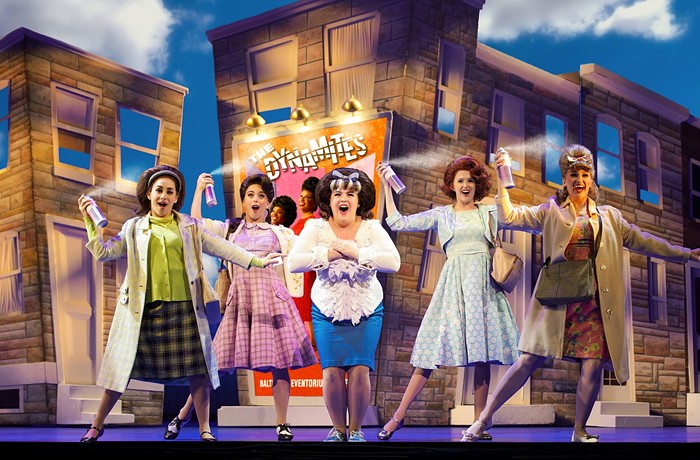
Much like the beloved and defunct New York City drag act Kiki & Herb, The Vaudevillians features hilarious reinterpretations of pop hits. (After introducing the next number as "a song about immigration," Hoffer began singing, "I fly like paper, I get high like planes. When you catch me at the border I've got visas in my name…") Unlike Kiki & Herb, The Vaudevillians featured Hoffer doing a handstand in the lap of an audience member. After the first of two shows last night—yes, two shows in a single night—Hoffer was seen backstage hugging his brother, his mother, his aunt, and his grandmother and telling them, "I have to go to Akron, Ohio in the morning." It's the start of the Absolut Drag Race Tour. After the Absolut tour, he'll frantically race home to do a concert version of Hairspray at 5th Avenue Theater and Freedom Fantasia at the Triple Door before flying across the country again to make his New York City debut in a 17-show run of The Vaudevillians. Get on those tickets, New York—most of the run is sold out. And: Fair travels, Mr. Hoffer. Please don't die from exhaustion!
This post has been updated since it was first published, thanks to Michael Strangeways.
I just watched Fela! at the Paramount, and it was a pleasure for those who are familiar with his work and a must for those who want a great introduction to it. There are four more shows left this weekend. Go!

I'm watching Broadway hit Fela! tonight at the Paramount, and one of the many things I want to determine is if Sahr Ngaujah, the man who plays the Nigerian pop genius, is too masculine. True, Fela had something like 30 wives and was also the patriarch of his musical community; but in mode, in style, in body language, Fela was very effeminate...

The image is the cover of the album Various Artists Black Man's Cry: The Inspiration of Fela Kuti.
A dear family friend—the same book-bestowing, martini-making, charming East Coast lady from this post—has given me another book. It is titled The Nasty Quote Book and its section on theater (spelled with an "er," for those of you who live to have your feathers ruffled) slays me.
Here's Noël Coward on Waiting for Godot:
It is pretentious gibberish, without any claim to importance whatsoever. It is nothing but phony surrealism with occasional references to Christ and mankind. It has no form, no basic philosophy, and absolutely no lucidity. It's too conscious to be written off as mad. It's just a waste of everybody's time and it made me ashamed to think that such balls could be taken seriously for a moment.
In fairness, Coward also wrote: "Stage musicals are gaily irrational to the point of lunacy."
One gets the sense Coward didn't like anything that wasn't Coward. Ogden Nash gets a Coward dig in the chapter:
Could I write as witty
As Noël Coward
By my self-esteem
I should be devoward.
Here's Brecht (channeling Marx) on Broadway: "Broadway is a branch of the narcotics world run by actors."
And Harold Clurman for the Nation on Who's Afraid of Virginia Woolf?: "The pessimism and rage are immature. Immaturity coupled with a commanding deftness is dangerous."
Arthur Wimperis on an unnamed play: "I saw it at a disadvantage—the curtain was up."
Dorothy Parker on another unnamed play: "If you don't knit, bring a book."
And Parker on Tolstoy's Redemption: "I went into the Plymouth Theater a comparatively young woman, and I staggered out of it three hours later, twenty years older, haggard and broken with suffering."
And Israel Zangwill on George Bernard Shaw: "The way Bernard Shaw believes in himself is very refreshing in these atheistic days, when so many people believe in no God at all."
Some of the lines are too vicious even for Slog. But here's one you all might appreciate from Oscar Wilde: "There is much to be said in favor of modern journalism. By giving us the opinions of the uneducated, it keeps us in touch with the ignorance of the community."
Amen.
This week we have a preview of FELA! at the Paramount courtesy of Charles Mudede who said that, at one point in his life, Fela Kuti was a hero of his—and that Fela was politically radicalized not by Africans, but by African-Americans.
Something to listen to while you read:
In a typical encounter between a black African and a black American, the black African knows more about the black American's world than the black American knows about the black African's. This has a lot to do with the fact that most Americans (white or black) know little about what happens outside of their country. But it's also because the United States exports a massive amount of culture and imports very little. As a consequence, a person in, say, Singapore consumes his/her local culture along with the culture that Americans consume almost exclusively. The US has become the universal—the rest, a puzzle of particulars.
When we talk about American cultural dominance, the discussion instinctively turns to brands like Nike, McDonald's, and Coca-Cola, and the image industrial complex called Hollywood. But blacks in Africa and countries with large black populations cannot imagine any discussion of American cultural dominance that fails to mention black American music, the music of the world. It is heard everywhere and imitated by everyone.
For the curious, and for the haters, a long interview with Saint Genet director Ryan Mitchell (about Paradisiacal Rites, about Shoot, about the Jackass phenomenon, about whether pulling a performance stunt like Shoot is just a cheap exercise of white-guy privilege, about Captain Ahab, about how one can love Brecht but still think he didn't get it quite right, about whether your opinion about anything matters at all, and more) is now up over here.
Here is some video documentation of Chris Burden's Shoot, with some spare commentary from the artist.
This morning, Theater Schmeater artistic director Douglas Staley sent out a press release saying the company would start looking for a new place to make theater.
Which means this run of The Twilight Zone: Live! will be your last chance one of your last chances to see a show in the subterranean venue that, in Seattle, has become synonymous with the term "basement fringe theater." (This summer's Game Show will be the final production in Schmeater's current space.)
The recent departure of the Brocklind's costume shop upstairs is the issue. In a subsequent email, Staley explained that the theater and the store had "a symbiotic relationship" because they had different business hours, so there were never noise problems. Now the upstairs space is going to house a restaurant and bar, and the theater ceiling is already so low, it can't build in sound muffling (which probably would only be marginally effective anyway).
"We are already at about 8'2" at the bottom of the cross supports," Staley wrote. "Putting in a ceiling and bringing down all of our lights means some of them will be maybe less than 7' from the floor. That precludes using any risers for the audience, or casting anyone over 5'6". Our light designers make miracles but that really is more than I could ask for."
But the future isn't all gloomy. He added:
At dawn last Sunday morning, in a remote and wooded area of Seattle, Saint Genet director Ryan Mitchell re-created Chris Burden's notorious 1971 artwork Shoot. In the original, Burden was shot in the arm with a .22 rifle inside a gallery and called it sculpture. Mitchell was shot in the arm with a .22 rifle beneath a tree, then walked approximately 10 miles to a theater and called it performance.
The re-creation of Shoot was secret—I had to sign a nondisclosure agreement before I was even told what was happening—because the stakes were high. First, the action was probably a crime. Second, there were some serious liability issues. Third, the action happened the morning before Saint Genet's closing-night performance of Paradisiacal Rites at On the Boards, and if On the Boards artistic director Lane Czaplinski got wind of it, he might've pulled the plug on the whole show.
The shooter, who has been hunting with guns and bows since he was 8 years old, stood in the dim forest with a few other people watching. He said there wasn't enough light for him to take the shot safely...
(A long interview with Ryan, in which he explains his rationale for all this, is coming soon. Also, apologies for forgetting to turn off the comments earlier. But if you want to talk about it, head on over to the story itself.)

At dawn yesterday morning, in a remote and wooded area of Seattle, Saint Genet company director Ryan Mitchell re-created Chris Burden's notorious 1971 artwork Shoot. In the original, Burden was shot in the arm with a .22 rifle in a gallery and called it sculpture. Ryan was shot in the arm with a .22 rifle, then walked approximately ten miles to the theater, and called it performance.
I walked with him. I was not exactly thrilled to be in the situation, but if it was going to happen anyway, I felt a duty to witness.
That was the beginning of Saint Genet's closing-night performance of Paradisiacal Rites at On the Boards. The top-two activities for Seattle just after dawn were jogging and homelessness.
There's a photo of the wound—for your own verification purposes—below the jump. More coming in next week's paper.
Gothic anguish, degeneracy, nakedness, wine, and a wheat field. Also, gold leaf, honey, tar, blood, wax, flowers, leeches, pheasants, and arrows. And Jessie Smith. And Jessie Smith choreography. And Jessie Smith wearing a weird cape thing with a very long tail with egg-carton-like shapes bulging from it. And music. And weird, beautiful acts of endurance. And gay shame and bullying. And the most perfect curtain call of all: None at all.
It might be sold out. Sneak in anyway.
And it has already included cops at dawn, with rifles drawn, trying to stop one of the performances.

Quick primer: Starting tonight, Saint Genet will be performing its Paradisiacal Rites at On the Boards. Saint Genet is an extraordinarily polarizing company that creates exquisite, and sometimes painful, "actions and images" instead of plays.
Actually, this week we have a preview by Melody Datz, based on her interview with the associate ballet master at Les Ballets Trockadero de Monte Carlo:

Raffaele Morra does not shave his chest, even though his professional wardrobe includes pointe shoes, a golden tiara, and yards of fluffy white tulle. For someone used to the traditional staging of classical ballets, it may be jolting to see a hairy, um, décolletage nestled into a frilly white Swan Lake costume, or to watch the uniquely defined musculature of male quadriceps peeking out from under a tutu while whipping through 32 fouettés. But the all-male company Les Ballets Trockadero de Monte Carlo makes it work.
The Trocks have been around since the 1970s but Morra mentioned to Datz that in the past several years, as drag aesthetics have entered mainstream culture, the company's audience has diversified. But they are not, he emphasized, drag—they keep their male personality and technique while dancing roles traditionally reserved for women.
This week's theater section is brought to you by the emotion Ambivalence. (Ambivalence: It is and it isn't™.)
I have mixed feelings about Mike Daisey at this awkward moment in his career:
Daisey is recalibrating. His observations seemed stale and flat-footed: Disney World is a bizarrely detailed consumerist fantasyland, Burning Man is disorienting and anarchic, Occupy revealed that power fears democracy and will break laws with impunity to suppress it. That's old news. And between the staleness of the information and the wobbliness of its presentation, American Utopias seems like the work of a performer who was publicly neutered and is still trying to find another pair of balls. They're out there, Mike. We want you to find them. Just keep looking—America is, after all, the land of reinvention.
(His upcoming show in Portland is, apparently, about how journalism works.)
Chow contributor Kim Fu has mixed feelings about Cafe Nordo's latest, Western-themed show:
Ian Bell’s crowdsourced carnival of anonymity will be going on hiatus for awhile, which is a shame, because it's one of the more regularly entertaining things at ACT Theater, and Seattle in general.
For the newcomers: Every three months, Seattle Confidential collects anonymous stories and gives them to actors to read. (Sometimes they add bells and whistles—PowerPoint presentations, charts and graphs, instant polls that the audience contributes to via text.) The confessional mode gives the writers a cloak to air their dirtiest, most hilariously awkward laundry, and everybody has a blast. It's like sneaking a peek at Seattle's diary.
And the event is also strangely comforting—we all have screwed-up stories and messed-up things we've done or had done to us. Laughing about them together feels therapeutic.
Before Seattle Confidential takes its indefinite break, Bell put together a best-of show. It plays tonight and tomorrow at ACT. Go check it out. Who knows where or when it will reappear? (Though I am confident it will—either ACT or some other venue will want it. It's too good to die.)
Now that the remodeling of King Street Station is finally completed, we can dream a little...

As therefore the sweetest rose hath his prickle, the finest velvet his brack, the fairest flower his bran, so the sharpest wit hath his wanton will, and the holiest head his wicked way. And true it is that some men write and most men believe, that in all perfect shapes, a blemish bringeth rather a liking every way to the eyes, than a loathing any way to the mind.How I can see and hear all of this happening inside of the renewed King Street Station.
Welcome to a preview of this week's theater section! Christopher already posted about this one, a review of Black Watch by the National Theater of Scotland at the Paramount:
It is an intimate show, and the cavernous Paramount Theater has reduced its seating capacity from 3,000 to 419 for the occasion. The audience sits on the stage, just feet away from 10 tightly wound actors who spring from a Scottish barroom to Iraqi battlefields and back again. During one transition, soldiers are birthed from the inside of a pool table, cutting its red felt open from below with a long blade and standing back-to-back on its top with long guns in hand, nervously scanning the audience.
There's also Assisted Living at ACT Theater:
Assisted Living, a world-premiere play by Seattle writer Katie Forgette, opens in an assisted-living facility that is actually a lightly veneered prison: bars on the windows, linoleum trim, dull gray-blue tile, cheap office furniture, and a photo of a smiling President Dick Cheney. This is the near future, where the economy is on the verge of collapse, and senior citizens have to pay for any medical treatment that might be even obliquely related to their former lifestyles (such as eating). They also have to pay for “toiletries,” including colostomy bags.
And a trailer-park Taming of the Shrew at Seattle Shakespeare Company:
The only problem I had with the comedy—other than Kate's earnest "submit to your husbands" speech, which I guess can't be helped—came from its setting. I understand the allure of launching a redneck revamp of Shrew... Hey, it's a trailer park! People are wacky! But such a production has to be careful to avoid abjectly mocking the poor. There's no need to use poor people for comic relief, especially when the production is no longer launched in a park (i.e., free! Accessible!) but costs $40 a ticket in a rich city that gets the vapors at the very mention of affordable-housing aPodments, let alone trailer parks.
A few weeks ago, we published a short essay by dance critic Melody Datz titled "Swan Lake Is So Goddamned Boring." Some local dance folks freaked out and enjoyed a sustained, satisfying whine. (Who knew that taking aim at a hoary, lucrative, sacred cow would be so provocative?) Angry blog comments, responses to those comments, a flurry of email from experts and amateurs, extended phone calls with dance people—including employees of Pacific Northwest Ballet—you name it. The indignados of Seattle dance never had it so good.
Snail mail, of course, takes longer. This arrived yesterday:

Which contained this:
You're on notice, Melody. An anonymous, snail-mail troll who calls you "Melody Ditzy Dame" says you have no class.
You'd better scrape some up before your next story, young missy. And that's an order.
Brendan Kiley's review of Black Watch won't be on Slog until tomorrow, and won't be in print until Wednesday, but here's the Stranger Suggest preview for Black Watch, and I just snuck a peek at Brendan's review, and this paragraph makes me very much want to see it:
It is an intimate show, and the cavernous Paramount Theater has reduced its seating capacity from 3,000 to 419 for the occasion. The audience sits on the stage, just feet away from 10 tightly wound actors who spring from a Scottish barroom to Iraqi battlefields and back again. During one transition, soldiers are birthed from the inside of a pool table, cutting its red felt open from below with a long blade and standing back-to-back on its top with long guns in hand, nervously scanning the audience.
The two-for-the-price-of-one tickets for Tuesday's and Wednesday's shows are available online and at the box office up until showtime with no password needed, according to Seattle Theater Group public relations manager Antonio Hicks.
I'm going tomorrow night.

OK, guys. Real talk. Truth time. I love theater when it's good, but I'm also easily bored. And theater can be… you know, boring. As hell. And long. It can be so long. Someone says "three-and-a-half-hour play" and my interest in seeing that play starts to power down. Someone says "two intermissions" and my panic trigger triggers. For these reasons, I'd never gotten around to seeing August: Osage County, even though it won the Pulitzer Prize and it's been produced in Seattle before and everyone always says it's great. In my defense, everyone is often wrong about things. Balagan Theatre's right at the end of their run of of August: Osage County, a production Goldy has raved about already, a production we told you on cover of The Stranger to go see, and last night I took our own advice and went and saw it. And holy moly with a Stoli, it's amazeballs.

We have to start with the title of the show. Adventures of Huckleberry Finn: Uncensored is a flat-out stupid name, and, depending on the motivations of Book-It Theater, it could be considered aggressively stupid. In order of offensiveness from most to least, those motivations could be:
1. Book-It believes that the censored version of Mark Twain's Adventures of Huckleberry Finn is widely accepted as the "regular" version of Huckleberry Finn, which makes an uncensored version noteworthy.
2. Book-It felt like it had to alert people to the presence of the word "nigger" in this play by passive-aggressively labeling it "uncensored" in the hopes of preemptively scaring off anyone who might be offended.
3. Book-It wanted to arouse the prurient interests of potential theatergoers by giving their play a name worthy of a porno (what's next from Book-It—This Ain't As I Lay Dying XXX?).
But here's the thing: When you label a book or a play "uncensored," you're actually scoring a point for the censors by normalizing censorship. You're making a lack of censorship into something extraordinary. And that's plain wrong: The uncensored text should always be considered the default position. Because fuck censorship. Fuck it right in its ugly fucking hemorrhoidal shithole.
Once you get past the title, Book-It's staging of Huckleberry Finn is actually pretty damn good...
Paul just posted about this new Wall Street Journal "ranking" of jobs by some metric of "best"-ness. But I would especially like to draw theater people's attention to the bottom job rankings:
196 Oil Rig Worker
197 Actor
198 Enlisted Military Personnel
199 Lumberjack
200 Reporter (Newspaper)
So you're on notice, actors! Your license to gloat (at me, anyway, but not oil rig workers) has just been issued. Your license to whine has just been revoked.
Also, knowing that I am lowlier than a military grunt in the eyes of the WSJ gives me a strange glow of satisfaction.
Yesterday, I was having a conversation with our (newly infamous) dance critic Melody Datz about the common notion that ballerinas get trained to do all kinds of nutty things while danseurs (aka, "boy ballerinas") mostly learn how to lift chicks and hold them in the air—that ballerinas are the branch, leaf, flower, and fruit of ballet, and danseurs are just the root.
"Oh no, no," Melody said and talked about about male dancers she'd known who'd take the pointe shoes out of their friends' bags and go take class.
A few hours later, she sent me evidence in this "pas de dudes" by her latest choreographer-crush Trey McIntyre. Enjoy.
Why, it's wounded members of the dance community! They're strange birds, those certain—not all, just some—members of the dance community. When we don't write about dance, they complain. When we write glowing criticism, they are silent. When we write questioning or negative criticism, they come out of the woodwork to insist that we're idiots and criminals and incompetent monsters.
You can't win. (I just mentioned this phenomenon to books editor Paul Constant, and he said: "Sounds like poetry! If I write something positive about poetry, nobody gives a shit. When I write something negative, suddenly I'm the Hitler of poetry.")
But we're used to that. It's been that way for years.
And it's that way again this week with Melody Datz's lovely, funny, and intelligent piece on Swan Lake at Pacific Northwest Ballet, which she's seen many times over the years, and adores for its athleticism (she's a former bunhead and still impressed by fouettés and such), but recognizes that, to many people, it's dull as dirt and a potential turn-off from all dance forever.
Though she talks about what she likes about this Swan Lake, and interviews a young man about how it was a gateway for him to other kinds of dance, commenters are (predictably) throwing fits.
I'd like to single one out for special mention, however, only because I've seen this sneaky trick a thousand times:
Melody—Headline aside, your attempt at offering us an inflammatory piece does little to establish your credibility as a dance writer new on the scene. I expected better from you. You've relied on crass prose and slang to make tired, cliched points. Leave the sensationalist vocabulary behind, step out of your comfort zone, and start writing something worth reading.
Doug Fullington
Education Programs Manager
Pacific Northwest Ballet
This is a classic—an employee of an arts institution suggesting that the critic isn't "credible" because she dared to write something negative about some hallowed work of art (and dared to use conversational, grown-up language while doing it).
But this is totally disingenuous.
When any journalist evaluates the credibility of a source, the first question to ask is: "What does this person have to gain? Does he or she have any incentive—especially a financial incentive—to spin this information?" Any employee of any arts palace has a financial incentive to be mad at a critic. As "education programs manager," Doug Fullington, by definition, has a professional stake in the public perception of Swan Lake. But he's the one questioning her credibility.
So Doug: If there's anyone who is less credible in the conversation than the critic, it's the person who has a financial stake in what the critic says.
And that's you.
By all means, employees of arts institutions are encouraged to join any critical conversation we have at The Stranger. But we are all aware of where your packchecks come from and how that might influence what you say. So be careful about dubbing yourselves the arbiters of credibility.