Reports are still coming in. The AP explains what's going on. The tornado reportedly struck an elementary school. To see live video and updates, visit Breaking News.
You know those peas I planted back in February? The first fruit are now on the vine, meaning my daughter and I will start enjoying sweet, crunchy snap and snow peas by this time next week. Yum!
What's in your garden?
From the mailbag this morning—yet another person selling us her p.r. services. (We get a lot of those, clearly from people who have no idea who we are or what we do. Here's one from yesterday: "What Can The Right IT Systems Management Tool Do For Loaded For Bear Publishing?" Hm. I dunno. Go fuck itself?)
Anyway, this morning's marketing email is about tattoos:
This past Saturday I was in a ballet class and noticed the tattoo on the dancer in front of me. Nicole had a large butterfly tattoo on her back. For me, this was a branding moment. I don't know Nicole that well, but I do know that butterflies are so meaningful to her that she wants one on her back for the rest of her life. According to a 2012 Harris Poll, one in five American adults has at least one tattoo, which is up dramatically from polls conducted in 2003 and 2008.
Tattoos are much more than body adornment, but have become a powerful expression of your individual brand. In fact, tattoos are the ultimate branding statement.
(Wouldn't being branded be the ultimate branding statement?)
Now that the Seattle weather is getting warmer and the clothes are getting scarcer, the tattoos are coming out—which always presents a dilemma for me. Last weekend, for example, I was at the beach and some of my fellow bathers were like walking billboards, if billboards were designed by stoned skateboarders: acronyms, sentences that didn't parse, arcane symbols. (My favorite was a jaggedly drawn dagger with the letters "PMS.") I wanted to ask about each tattoo's back story, but didn't. It felt like prying. But p.r. lady says tattoos are branding, and de facto public.
What do you think, Sloggers? Now that summer is here, is it okay to ask strangers about their tattoos?

The problem...

This post owes its existence to Madeline Reddington.
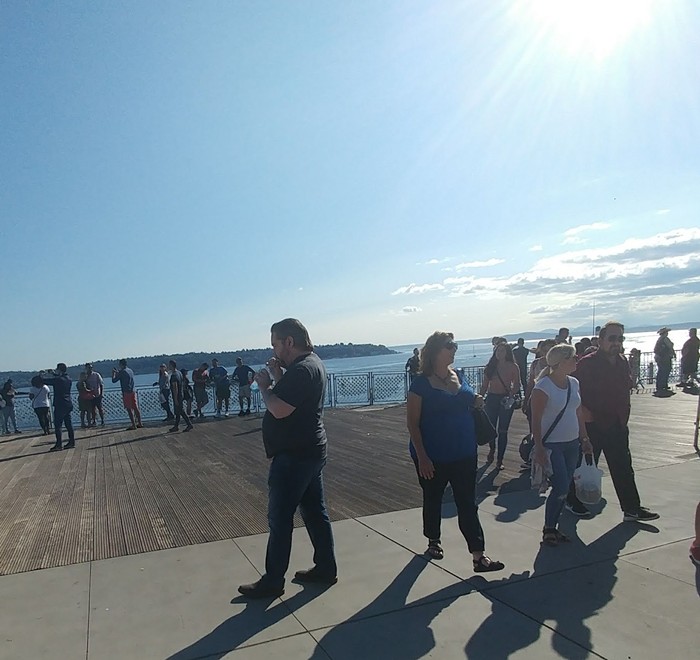
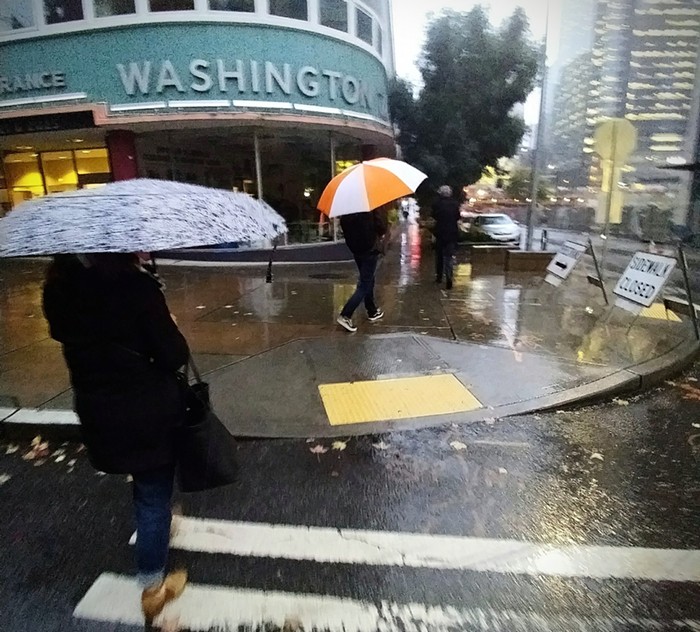
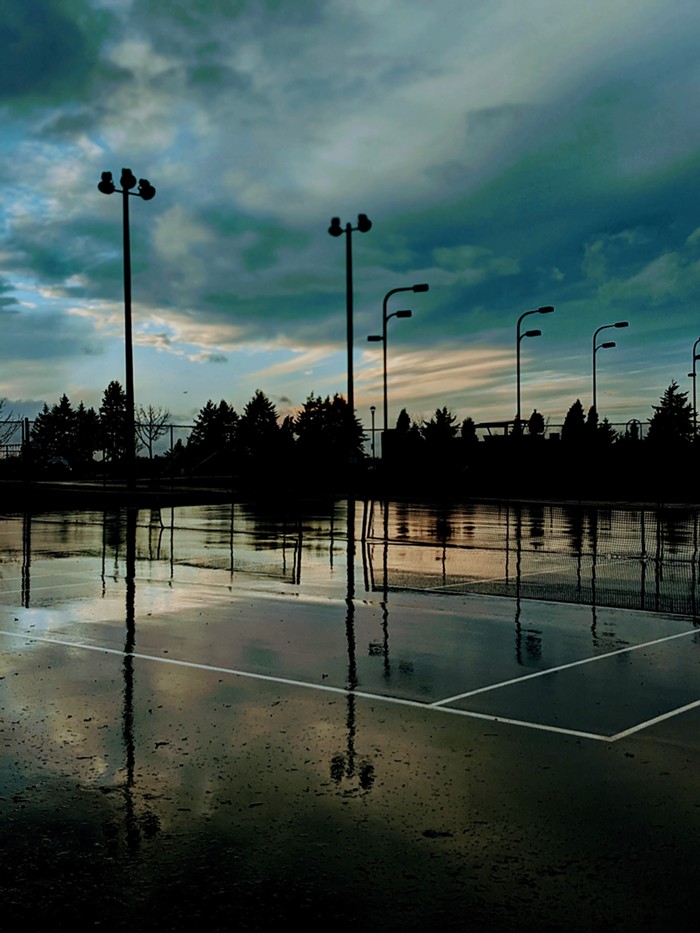
The sky is only moderately gloomy with no precipitation at the Stranger Weathercenter at the moment, but the weekend looks wet:

Let the showers of April begin! (Note that the sky is predicted to be just mostly cloudy for Mariners opening day on Monday—fans, cross your fingers.)
Don't be inside! Frolic in the sun! Stop reading Slog!

(PS — I just read this wonderful feature story by Susan Dominus in the park.)

A constituent asked me earlier today, "Sally, isn't it a nice day?" I'm glad this passerby raised the question. It was a qualitative inquiry that my colleagues on the Seattle City Council and I have been asking ourselves since widespread interest about today's status was introduced to our attention by our interim communications manager, Dan Nolte. First, as council president, I want to recognize that many neighborhood groups have important perspectives about today's niceness, and we as Council are foremost committed to recognizing the concerns and interests of Seattle's vital neighborhoods—where we live, work, and play—when coming to conclusions about whether this is a nice day or not.
Naturally, I cannot presume to speak for the entire city on this matter. Although some Seattle residents appreciate that the gleaming rays of sun are warm, and see warmth as a welcome instance of outdoor comfort after a string of many cool days, other people with certain skin conditions might justifiably note that UV rays aren't without consequence for some individuals. We are listening closely to those concerns. And while others embrace the gentle breeze and the sweet scent of blossoms in the air, we know that irritating allergens also ride on those winds. Others still tell us of unwelcome, frigid gusts.
Overall, it would be premature to make a subjective judgement about today's niceness.
Certain elected leaders at City Hall might jump to make a conclusive determination that "today is indeed nice" without considering all of the information available. But as the grown-ups in the room—that is, my seven Council colleagues whose first names don't rhyme with "trike"—we naturally require a data-driven, comprehensive examination of the full day. Some eight hours remain, and we think it would be a mistake to prejudge the day before accounting for the full 24 hours.
Within the coming weeks, the Council will announce a schedule of public hearings in order to provide comment from citizens on how they feel about whether or not the day is nice. The Council then will consider whether to make a final determination of the issue via councilmanic action or by referring the question of day niceness to the ballot for a public vote.
Thank you for your interest, and have a nice day.
It's cloudy and damp this morning at the Stranger Weathercenter, but expected to be mostly clear this afternoon with a high around 63. AND THEN LOOK!
Canoeing in the Arboretum sounds good...
Big, wet, fluffy flakes are descending at the Stranger Weathercenter (as originally reported in Morning News). The snow is expected to magically turn to sunshine later today with a high of 48 degrees (and cold [for Seattle] again tonight). Here is Cliff Mass on the timely topic of "How Low Can It Snow?" It is, indeed, the third day of spring.
This morning in Seattle, it was fearsomely dark and raining insanely. Now the sun is making a concerted effort and puffy white clouds are skidding across the sky.
Time, again, for lovely leaves on those stick-branches!


Two weeks ago, I direct sowed peas, lettuce, and arugula, and it turned out to be perfect timing. Since then the weather has been relatively warm and wet, providing the ideal conditions for germination. I peeked under my floating row covers this weekend to find neat rows of arugula and lettuce sprouts, along with a bed full of snap and snow peas just starting to poke above the surface.
There's still plenty of time for things to wrong: a hard freeze, relentless pounding rains, malevolent pests and other wildlife. I found a largish slug in the pea bed with a trail of slime and destruction behind him. Our mild winter has virtually assured a nasty slug and snail problem this year. But there's a good chance that backyard gardeners who cast seeds early this year will likely be rewarded with an earlier than usual first harvest.
As for my overwintered crops, the surviving lettuce and collards look awfully ugly at the moment while the kale and mustard continue to produce. I'm guessing I'll be damn sick of kale in another month or so. But a small patch of broccoli raab is providing an unexpected late winter treat. I'd actually planted it as a fall crop, and got a disappointing harvest, but am getting a tender second crop from the surviving plants.
...and here is your weekend forecast (minus Sunday, which does not inspire all-caps) via weather.com:
From the Smithsonian:
... dust blown from as far away as the Sahara desert of Africa can seed rain and snow clouds in the Sierra Nevada mountains of California.
Cloud formation depends upon tiny particles such as dust that serve as cloud condensation nuclei or ice nuclei—flecks that act as a surface on which water can condense. Previous studies have found that dust from as far away as the Taklimakan desert in China can be blown around the globe. But temperate deserts such as the Taklimakan and the Gobi are frozen much of the year, while the Sahara never freezes, the researchers noted. Could the Sahara and deserts in the Middle East serve as a significant source of year-round dust which, when lofted high into the atmosphere, seeded storms across the planet?
The answer is yes. Of the six storms the researchers sampled, all showed at least some trace of dust. Then, working backward to determine the origin of each of these air masses and using existing data from previous studies on wind currents across the Pacific, they found strong evidence that the majority of the dust had originated in Africa, the Middle East or Asia and traveled around the globe. Additionally, the observed height of various drafts of dust (as collected by a U.S. Navy program) on the days when the air masses would have moved past the African and Asian regions matched the altitude necessary for the particles to get lifted up into the air currents.
Also on the Smithsonian blog, geneticists are tracking human migration around the globe by looking at the genetic diversity of the lice we carried with us.
I've got a hunch I'll be blowing most of today on science blogs.
The map is here. What it shows is that the world map of human races corresponds with the world map of Mean Average Temperatures. See, race begins and ends with place. The anthropologist Nina Jablonski is a leading proponent of this way of thinking...
Indeed, I think our ability to cooperate with strangers (the true genius of human socaility) may have something to do with the speed with which we spread around the world, our newness, and general genetic closeness rather than a consequence of cultural evolution and the social markings that Peter J. Richerson and Robert Boyd discuss in their important book Not by Genes Alone: How Culture Transformed Human Evolution. We have long to go before we reach the noon of the universal subject

If you want more celebrity bullshit posts, post 'em. And please note that the two Seahawks posts were by regular actual employees of The Stranger, and one of them was so disdainful as to actually constitute a Golden Globes post.
And the Seahawks game was more important: There's a Golden Globes every year. The Seahawks do not make the post-season every year.

The Office of Arts & Cultural Affairs, in partnership with Seattle Public Utilities (SPU), is seeking two-dimensional or three-dimensional artwork depicting weather-related or atmospheric phenomena for a competitive, direct purchase for SPU’s Portable Works Collection. The rotating collection is exhibited throughout the utilities’ offices, engaging both employees and the public by helping to create an interesting and diverse work environment.
Artwork should reference air, water, temperature or light and may or may not be representational. All types of media will be considered. Artists working in color are encouraged to apply.
The call is open to professional artists residing in Washington, Oregon, British Columbia, Montana, Idaho or Alaska. Applications close 11 p.m., Jan. 28, 2013 (Pacific Standard Time). To apply, artists may submit up to 10 images of artworks that are available for purchase. Multiple artworks by an individual artist may be purchased. Go to www.seattle.gov/arts for a link to the online application.
A total of $125,000 for all artworks is available for the direct purchase. The purchase is made possible with SPU 1% for Art funds administered by the Office of Arts & Cultural Affairs. Purchases will be chosen by a panel of arts professionals who are charged with selecting high-quality artwork that reflects diversity of expression.
Now, despite the fact that it's weird*, calling for weather-related art has every chance of resulting in good art being selected by the panel that will be put together by the Office of Arts & Cultural Affairs. But in any case, here are a few tips for artists hoping to satisfy the city's classified ad:
1. If your art is not "weather-related," do not fret! Rather, begin to devise how it references "atmospheric phenomena." Paintings about your ex=like that time lightning almost struck your house. Begin the massaging of metaphors in your artist statement now.
2. The sentence "Artwork should reference air, water, temperature or light and may or may not be representational" should in all fairness replace the word "but" for the word "and." The willy-nilly, overly amicable use of "and" rather than "but" in conflict-avoidant Seattle ought to be banned. Is it just here, Internet? Is this happening everywhere?
3. Since the art should "reference" weather but need not "represent" it, artworks only have to nod in the general direction of "air, water, temperature, or light." And who can ever tell exactly where any nod points, hm? Whiting Tennis's trompe l'oeil painting of a blue tarp, though evidently "about" a blue tarp, might fairly be said, under the rules of May Or May Not Be Representational But Is Referencing A Thing, to nod in the general direction of least air and water and, arguably, temperature and/or light.
4. Perhaps the best way to make your artwork relate to the weather is simply to make something inscrutable but somehow the color of air, water, or light—any color!—then say it is related to the weather. Or, as discussed previously, atmospheric phenomena, which are as infinite as can be.
5. You really ought to reconsider if you work in black and white. Apparently, people who work in city offices—where these artworks will be displayed—want color. And they are not alone. In a project from a few years ago by the Russian artists Komar and Melamid—in which they created the world's most and least wanted paintings by surveying 1,001 people to find out what they most wanted to see (written survey results here, actual artworks depicted here)—pretty much nobody wanted their painting in black and white.**
May the best, or let's say the most phenomenal, artist win.
*Who decided this round of collecting had to be dedicated to weather art? I would love to see that memo.
**This rule may or may not apply to photography, but that's tough luck for you if you shoot in black and white and want your art seen in the offices of the City of Seattle.
The culture critic Steven Shaviro describes a SF novel, Dark Eden, by Chris Beckett...
The novel is set on a dark planet, one that does not circle any sun. The only energy source is geothermal, arising deep within the planet’s core. Plant and animal life forms have evolved, using this energy for fuel. “Trees” and other plants draw up heat energy from deep beneath the planet’s surface, and provide the ecosystem with warmth and light...
This strange planet looks and feels a lot like Seattle in these past few days...

The 1944 song "Baby, It's Cold Outside" gets a bunch of play around the holidays, and I had long ago written it off as being super creepy (some have even called it the "Date Rape Christmas Carol"). This is why I was surprised to read the feminist magazine Persephone had published a defense of "Baby, It's Cold Outside." The feminist reading of the song claims that the message conveyed is actually one of sexual independence, at a time when a woman could not blatantly voice her desires. The woman in the song is having a great time and wants to stay over, and her date is simply offering her excuses that she needs to give her family and community in order to do what she wants to. The fact the song ends with the woman doing what she wants to do, not what everyone expects her to do, is inherently a great message. The biggest criticism of the song is centered around that "say, what's in that drink" line:
"Say, what’s in this drink” is a well-used phrase common in movies of the time period, and isn’t used in the same manner any longer. The phrase generally referred to someone saying or doing something they thought they wouldn’t in normal circumstances; it’s a nod to the idea that alcohol is “making” them do something unusual. But the joke is almost always that there is nothing in the drink. The drink is the excuse.

Maybe it's that we're all paying closer attention because, you know. Still, I keep having conversations in which this winter's rain is said to be coming down harder than normal, or thicker than normal, or with more to-the-point efficiency and less of that familiar lingering ambivalence. Well, Slog?
We're in for a wet one, huh?
WeatherOn is a weather website run by a high-school freshman in Marysville and some UW students, which is a thing I would call SUPER CUTE if that didn't sound belittling. WeatherOn meteorological mastermind (and the freshman in high school) Tanner Petersen hastens to let us know that the site is in "a very early stage of development... but my goal for the future is to make this site the 'Facebook of weather sites,' where people can create and share interesting meteorological material. Right now I’m working on coding up a live chat program so that people can sign up and chat about the weather, or they can be in contact with me and my bloggers live." Cool.
Here is WeatherOn's "Start of the Ski Season" report. Baker's looking good!
If we weren't ruled by the worst people in the world, there'd be an immediate an massive dontcallitastimulus relief bill about 5 minutes from being on the president's desk which would, among other things, give immense amount of money to the MTA to fix and renew the subway.
New York can't really function without the mass transit system working. I'm not sure if the Galtian Overlords who profit from that city understand that.
There's a team of truth-in-photography checkers at The Atlantic today. You can send them images you're seeing of Sandy to find out whether they're real. Dog on man's back in chest-high floodwaters? Fake—not from this storm, anyway.
The writers are doing more than making a game of gawking at disaster. (Images like this are reminders of why not to do that.) They're delving into the old but fascinating question about how true photographs can be, and what kind of true.
For instance, have you seen the shots taken last night of Goldman Sachs, which stayed lit up by using generators while everything around it, including the Freedom Tower, went black? These images are satisfying shorthand for the disastrous financialization of the economy.
But Alexis at The Atlantic points out that Goldman Sachs always looks more lit up than everything around it, even on regular nights. And also, that the most striking photographs from last night probably have the contrast punched way up to accentuate the difference between Goldman Sachs and everything else. Yes, Goldman Sachs is the evil empire; no, Goldman Sachs does not stand alone.
For now, we probably can't do much more than try to look carefully. Here's an image of a small Niagara formed at Ground Zero.
Have you looked through the slide show on the home page of the New York Times? So much water. At least 26 deaths in seven states. Our thoughts are with you, people of the East Coast.
Having lived in Brooklyn for four years (near Carroll Street station, a few blocks in on the F train), it is hard to imagine New York City functioning without its subway system, yet transit authority officials have no idea when they'll have it running again:
The giant storm Sandy wreaked havoc on the New York City subway system, flooding tunnels, garages and rail yards and threatening to paralyze the nation's largest mass-transit system for days.
[...] All seven subway tunnels running under the East River from Manhattan to Queens and Brooklyn took in water, and any resulting saltwater damage to the system's electrical components will have to be cleaned - in some cases off-site - before the system can be restored, MTA spokeswoman Diedre Parker said on Tuesday.
[...] About 5.3 million people use the city's subway system on weekdays. The system, which runs around the clock, comprises 21 subway routes linked by 468 stations, and stretches across 660 miles (1,050 km) of track.
For many of these 5.3 million daily riders, the subway is the only way for them to get to and from work. I didn't know anybody in the city who owned a car, and there's no way the bus system could even begin to pick up the slack.
You know how when it snows in Seattle, sometimes some buses don't run? Multiply that by infinity and you've got an idea of what's going on in New York.
Even in something as destructive as the superstorm Sandy, there are moments of heartbreaking beauty.
Rising water threatened the cooling system at the Oyster Creek nuclear plant, in Toms River, N.J., on Monday night. The plant declared an alert at 8:45 PM, which is the second-lowest level of the four-tier emergency scale established by the Nuclear Regulatory Commission.
The water level was more than six feet above normal. At seven feet, the plant would lose the ability to cool its spent fuel pool in the normal fashion, according to Neil Sheehan, a spokesman for the Nuclear Regulatory Commission.
The plant would probably have to switch to using fire hoses to pump in extra water to make up for evaporation, Mr. Sheehan said, because it could no longer pull water out of Barnegat Bay and circulate it through a heat exchanger, to cool the water in the pool.
Having first come online in 1969, Oyster Creek is the nation's oldest operating nuclear reactor, and is of the same design as those that failed at the Fukushima Daiichi plant. The reactor is located 50 miles east of Philadelphia and 75 miles south of New York City; 4.5 million people live within its 50-mile radius.