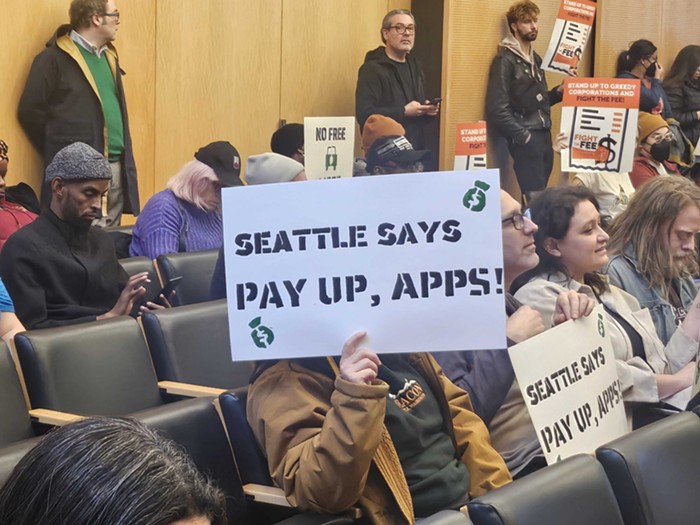
"Sorry for the crappy photo," says Slog tipper Andi, "but there are people protesting outside of Jimmy John's on 3rd Ave with signs that say 'Don't eat here! Support Jason!' Who is Jason anyway?"

No idea. Labor dispute? Viral marketing? Anybody?
...might as well tag it.

Funny, I don't remember ever seeing graffiti—or garbage—on or near the Wall of Death back when it was a skate spot. It still looked pretty pristine when I took this picture just days after the city decided to ruin the Wall of Death. Now there's graffiti on the columns and on those pointy conical posts and garbage strewn all over the place. Mission accomplished, SDOT.
A bunch of HazMat trucks and emergency response vehicles outside of PacSci — did they blow up a lab or something?-Slogtipper Jacqui
No, Slogtipper Jacqui, they did not. According to Seattle Fire Department spokeswoman Helen Fitzpatrick, more than a dozen Seattle Fire Department units are on scene at the Pacific Science Center to deal with a chemical spill.
Fitzpatrick says 10 gallons of muriatic acid—which is used to clean pavement—was spilled inside a room at the center. No one was injured.
Driving north on Aurora a few minutes ago. To my left, mountains in the distance burned orange with a bright blue tint surrounding, like a pilot light. To my right, mountains in the distance looked like someone held a dim light against a sheet of paper stained fully with dark, purply ink. In front, there were purple and white flashes of three police cars pulling someone over.
I had to tell someone. It looked incredible. I'm going back outside.
(Best I could do, since I didn't have camera handy... photo by Veo)
Today is the last day of amnesty for parking tickets in Seattle. This means no collections fees and no interest if you pay your tickets by the end of the day. I just paid off 12 tickets at a total of $625. (I used to be really bad at time-management.) If you don't know your ticket or case number, you can call 206-684-5600. If you do know your number, you can pay it here. The court closes in less than three hours. Godspeed.
Also, I regret knowing that I'm helping pay for these:

Mayor Greg Nickels is speaking to the SODO Business Association at the Starbucks Center today over lunch. According to a description on Ustream.tv, the company livestreaming the talk, "He requested this get together to review the many issues here in SODO. It will be set up town hall style to encourage open dialog. Bring your questions." Nothing to see yet except SODO Business Association's dizzying logo, but he's supposed to show up soon. It's underway:
UPDATE: Apparently we crashed the livestream. "System overload," the company doing the streaming tells me. "Should be back up soon. Also, they're taping it so there will be a full archive."
The King County Juvenile Detention Center has been forced to halt all visitations because of a sewage backup at the facility.
According to Adult and Juvenile Detention Captain Troy Bacon, sewage flooded the detention center's visitor area earlier today, soaking carpeting in the room. Capt. Bacon says the areas where detainees are housed was not affected.
This isn't the first time something nasty has come out of the pipes at the King County Juvenile Detention Center on 12th and Alder. Last year, I toured the aging facility—which was built in 1952—and was shown water fountains that spouted brown water, as well as other parts of the facility which have been mothballed due to flooding, mold and other structural problems.
Staff at the facility say the detention center is desperately in need of renovations, but the cash-strapped county—which has a budget deficit of about $50 million—doesn't have the money to pay for it.
Update: As of 4:30 pm, visitations have been moved to a separate area while the facility is depoopified.
Everyone loves how the city's plans to begin installing LED streetlamps across Seattle would save energy. But a near-universal sentiment of people living in the seven areas where the city is testing the LEDs is that the lights are unsettling; unlike the orange-ish color of the existing lights, the LEDs cast blue-green beams and make neighborhoods look like sets of zombie movies. As I note in this week's paper, the issue isn't purely aesthetic:
According to Dr. David Avery—a professor of behavioral sciences and light therapy at the University of Washington and the region's leading researcher on the impact of light on human chemistry—the LED lights could interfere with human biorhythms. Certain photoreceptors in the eye's retina react to cooler colors of the light spectrum, sending a signal to the brain that the sun is up. When humans see the blue light, our bodies think it's daytime. "The sensitivity to these cells for the blue and greenish color makes perfect sense, because the sky is blue. So for millions of years, life has evolved with this 24-hour rhythm of blue light being very prominent for part of the day and then darkness," he says. "This is kind of a conductor of a circadian symphony in the brain and body."According to Avery, "Theoretically, if someone has one of these LEDs or a blue light outside their window, it could fool the eyes and the brain into thinking that the sun is still up, so the melatonin hormone might not rise normally and sleep might be disrupted."
The full article is here.
I hadn't been thinking about foie gras, but the NARN protesters have been showing up every weekend outside Lark and Quinn's chanting about, talking about, and passing out flyers about the delicious, rich, buttery delight that is foie gras. They wanted us to think about it, and I couldn't evict the thought from my mind. So last Friday, a good friend and I poured some Champagne and devoured a giant bloc de foie gras.

Thank you for the great idea, NARN. Meanwhile, Critical Mass was winding though the streets of downtown, blocking traffic and irritating rush-hour drivers. Here they are, happily disobeying the rules of the road on Fifth Avenue:

And in the Midwest, the Des Moines city council was getting real about how to handle the insufferable, unpredictable killers known as Pit Bulls:
A Des Moines City Council member has come out in favor of a pit bull ban while local leaders weigh tougher regulations on breeds of dogs deemed vicious in the city code.Councilwoman Christine Hensley said the volume of complaints and concerns she's fielded about pit bulls over the years has moved her to back a ban.
What an excellent Friday.
Rebecca Hale, spokeswoman for the Mariners, says, "We’re disappointed that we didn’t win," referring to the case the team just lost, attempting to banish a strip club—the horror—from opening near Safeco Filed. The team hasn't decided whether it will appeal the decision. "We’re going to take some time to digest the judge's written decision," she says.
The Mariners are such a worthless embarrassment. For those keeping score: The team lost 101 games, $4.5 million, and had the most poorly attended season since the team moved to Safeco Field last year. And now team also lost this lawsuit that it filed last year. Considering Seattle voters rejected the prudish four-foot rule by a 26-point margin in 2006—indicating that we don't give a shit about strippers closer to us than four feet, and certainly not strippers way down in SoDo—I assume that this lawsuit will keep driving crowds away from Mariners games. Why waste our money on tickets that go to a losing team that uses its dough on an unpopular, bullshit, moralistic crusade?
King County Superior Court Judge John Erlick ruled a few minutes ago that a Déjà Vu strip club is allowed to open a half-block south of Safeco Field. The prudish Mariners and the authority that runs Safeco Field had filed the lawsuit that attempted to reverse an earlier decision by the city to allow the strip club. Erlick dismissed the crux of the argument, writing that the Mariners failed to prove that Safeco Field or the surrounding areas qualified as "public park and open space use," which, under a 2007 city law, would require an 800-foot buffer zone from strip clubs.
Attorneys for the Mariners had argued that a 60-foot-wide sidewalk south of Safeco Field with a few benches constituted such a "park and open space use."
“Most significantly, here, Safeco Plaza operates as an overflow parking area, essentially auxiliary to the adjacent parking garage," Erlick wrote in his decision. "Such a use for parking and traffic is inconsistent with park uses for recreational and esthetic proposes."
Of course, the Mariners wern't driven by a passion for open space. The team is attempting to claim moral high ground over stripping. In its petition filed in December, the Mariners said Déjà Vu strip clubs have “adverse impacts repugnant to a family entertainment environment.”
The city’s Department of Planning and Development decided in December that the club could open near Safeco Field. The Mariners appealed the decision to the city’s hearing examiner later that month, but promptly lost the case. The Mariners and Safeco Field filed the lawsuit in King County Court on December 23.
“I suggest they stick to baseball where they have a lot better chance of bringing some credit to their organization,” says the attorney for Déjà vu, Peter Buck. He expects the Mariners to appeal this decision but believes he will win any further court cases. “We have conducted video surveillance of that area during every Mariner game starting May 15, 2009. The photographs show that it is indeed a huge parking lot—not a public park. We have a photo display. The days of misrepresentations by the Mariners are over.”
Illustration by Robert Ullman
Of course Michael Jackson. Other topics we'll allegedly be talking about on KUOW's Weekday this morning: Cantwell's lack of enthusiasm for the public option, new polling in the county executive's race, McDermott's earmark for the Rainier Club, and... new Nixon tapes!
That's 94.9 FM starting at 10 a.m.
Two weeks after Kate Martin demolished part of the skatepark in front of her Greenwood home, Martin says she's settled a suit filed against her by the city and is looking to bring skaters back to her block.
From my story:
In October, the Seattle Department of Transportation (SDOT) sent Martin a letter ordering her to demolish the portion of the park that sits on the city-owned planting strip. Although 80 percent of Martin's skatepark is on her property, an 18-foot-long, 2-foot-high half-moon-shaped concrete wall—which Martin refers to as a "clamshell"—covers most of the parking strip in front of her house. The city wants the clamshell gone, but removing it, Martin says, would compromise the safety of the skatepark.
Photo by Kelly O
After demolishing the clamshell, Martin has settled the city's $100,000 suit for just $275. Now Martin says she will apply for a street use permit and enter into an indemnity agreement with the city, which would allow her to rebuild her front yard skatepark.
I've got an email into Martin about the status of her permit application.
Photos of the demolition after the jump.
Considering that the city funds and manages Seattle Center like a city park, then a park's rules for free speech ought to apply there, too. The 9th Circuit appeals court agrees:
Seattle Center rules aimed at addressing complaints about street performers making too much noise, blocking access or aggressively seeking donations are unconstitutional, a federal appeals court ruled Wednesday.The 8-3 decision by the 9th U.S. Circuit Court of Appeals reverses an earlier ruling by a three-judge panel of the same court.
The original lawsuit was brought by Michael Berger - known as Magic Mike - a magician who performed at the downtown center. He sued the city and Seattle Center in 2003. Berger objected to regulations issued in 2002 that required street performers to obtain a permit, to wear a badge displaying the permit, to not aggressively seek donations, to limit performances to 16 designated locations and to not engage in "speech activities" within 30 feet of most visitors to Seattle Center.
Next someone ought to challenge the backward rules for holding protests and rallies there. Right now, a big free-speech event like gay pride is required to hire the Seattle Center staff and pay tens of thousands in fees to use the space. That, in part, is how Seattle Out and Proud got into about $90,000 of debt holding the pride festival there in 2006 (now a company holds the festival while SOaP only runs the parade). But those regulatory fees don't apply to gay pride or Hempfest in city parks; they shouldn't apply in Seattle Center—an underused concrete tundra that's empty most of the year—either.
This just in from Last Days' Hot Tipper Spenser:
This may be too late of a tip for this week's Stranger but I am compelled to share. On Sunday June 21 (Father's Day AND Summer Solstice) I was driving eastbound on Mercer towards I-5 to go to a wedding with my girlfriend. We got slowed up in traffic in front of one of those newish office buildings. Though the windows are mirrored, the light was hitting the glass in such a way that we could see through the window pane and spotted a guy on the first floor of the building wildly masturbating into a potted plant. He had his shirt pulled up to prevent sperm blotching, his shorts were pulled to his knees, and he was staring out at traffic while crouched over the potted plant. Bam! The shock of that sight resulted in instant tabula rasa and provided a juicy story to share with everybody at the wedding. I told the groom it was a good omen but he seemed a bit skeptical.Cheers!
The city council passed two bills this afternoon that will preserve the 107-year-old University Heights building as a community center. The Seattle School District, which closed the elementary school in 1989, still owns the one-block property at NE 50th Street and University Way NE. But the district has been closing schools and selling properties for years, such as Queen Anne High School which was converted into apartments and later into condominiums. “They could have sold it for condos or something else,” says City Council Member Jean Godden, sponsor of the bills passed today.
Godden explains that the first bill releases $2.5 million dollars, approved in 2008, “when we were pretty fat,” to help the University Heights Center for the Community Association purchase the building from the school district. The group must continue to use the building as a community center—such as renting the space for child care, district Democrat meetings, and arts education—for the next 15 years. The second bill designates one-third of an acre of the parking lot on the south side of the building, the location of the University District Farmers Market, for use as a new park. “This ensures that you will continue to have the farmers market there because the city owns it,” she says.
Photo via Seattle Schools (.pdf)
The city's Ethics and Elections Commission (SEEC) says it won't be filing ethics violation charges following an investigation into allegations that some city officials received preferential plow treatment during Snowpocalyspe 2008.
According to the SEEC's report, investigators interviewed plow drivers and examined 1,000 reports on plow routes, and found "no evidence that Mayor [Greg] Nickels...or any other elected officials misused their official positions to secure special treatment from [the Seattle Department of Transportation] during the storm response."
Although a plow driver told investigators that former city transportation manager Paul Jackson had informed drivers that clearing streets in front of the mayor, deputy mayor and SDOT director's homes in West Seattle was in their "best interests" and would "make [them] all look better," the report says, the SEEC did not find enough corroborating evidence to charge Jackson with an ethics violation.
Some folks seem to detest Mayor Greg Nickels's plan to conserve energy by replacing 40,000 streetlamps, which currently give off a warm orange-ish hue, with bright white LED fixtures. The city has been testing some of the new lamps on several blocks of Capitol Hill. “The white light looks like a grocery store aisle,” wrote The Stranger’s Anthony Hecht in the comments of my post yesterday. “Or a morgue,” replied commenter pissy mcslogbo. "They make the streets look straight out of a narc film," said margotpolo. Until a couple days ago, Seattle City Light maintained a survey on its web page for citizens to register opinions about the new lights, but, coinciding with the mayor's big announcement, that survey disappeared.
“Mostly the response has been very positive about the feeling of the light but also that the city is looking into the new technology,” says Seattle City Light spokesman Mike Eagan.
But not everyone feels so “positive,” clearly. If you want to complain (or praise) the LEDs, you can call Mike Eagan at his desk: (206) 615-1691. You can even request a 10-question survey to express your opinions about the color, brightness, etc. of the LEDs. (Christopher suggests the city could cover the bulbs with yellow glass or plastic to mellow the abrasive bluish-white glare.)
The city is currently conducting tests of the new lights—using different brands of lights, at varying levels of brightness—on nine blocks on Capitol Hill, and will begin tests in the South Park neighborhood. Some have been getting a warmer response than others, Eagan says.
“We will be looking at those lights that people subjectively prefer but also meet criteria for the amount of light they cast on the street,” Eagan says. LEDs, which are directional, cast less light pollution than the existing high-pressure-sodium bulbs, he adds. The new lights also save electricity, and they last about 12 years, three times longer than the existing bulbs, which will reduce maintenance costs. The city will pick the winning LEDs this year and begin installing them in 2010.
Photo (which is not actually an LED light) by kevindooley on Flickr.

Then you should consider signing up for Equalityoga, the big gay yoga event going down next Saturday, June 27, at Cal Anderson Park, as part of the Celebrate Stonewall fest.
Find full info—including photos of the event's visually appealing master yogis—here.
The orange cast on many Seattle streets at night will shift to a white glow over the next six years as the city replaces streetlamps with new LED fixtures. Mayor Greg Nickels announced a plan yesterday to use federal stimulus funds to begin replacing 40,000 of the high-pressure-sodium bulbs with the light-emitting diodes to save money and energy.
“They would save about nine million kilowatt hours and about $408,000 a year,” says Seattle City Light spokesman Scott Thomsen. The power saved would be roughly equivalent to 750 single-family houses, which, he says, use about 12,000 kilowatt hours a year.
Funding to kick start the program comes from a $6.1 million stimulus grant to reduce energy use, including weatherizing buildings and installing energy-efficient products. Of that money, $1 million will go toward the streetlamp program next year, assuming the Department of Energy approves the expenditure this summer. In all, the new streetlamps will cost about $20 million.
The city is already testing several different brands of LEDs in several blocks of the Capitol Hill neighborhood. “People describe it as a little brighter, a little whiter,” says Mike Mann, director for the city’s office of sustainability.
Seattle City Light maintains approximately 84,000 street lights, including 20,000 outside the city limits.
Photo via alykat on Flickr.

Two years ago, we wrote about poor old Washington Hall (and poor old Oddfellows Hall and poor old Eagles Aerie #1):
A mile and a half south, in an office on the corner of 14th Avenue and East Fir Street, Charles Adams is sitting in his office in Washington Hall, waiting to talk to a developer. Adams is a lawyer, a wearer of suits and signet rings, and he presides over the Sons of Haiti, an African-American Masonic lodge. A few of the younger Sons, some with dreadlocks, sit quietly. They're waiting for Mark Blatter, a developer from Historic Seattle, to discuss the sale of Washington Hall.The Hall is a dilapidated building with a dignified history. W. E. B. Du Bois, Marcus Garvey, and Martin Luther King Jr. spoke in its theater and Count Basie played there, as did Ella Fitzgerald, Duke Ellington, Ray Charles, and Jimi Hendrix.
It was built as a community center by a Danish brotherhood, with meeting halls and one-room apartments for new immigrants. In 1973, the Danes sold the building to the Sons of Haiti, who kept the building active, leasing to tenants like On the Boards. But the Sons have grown too small for Washington Hall and let it fall into disrepair. Now there are missing windows, pigeon shit on the inside, and, on the outside, soft green columns of moss and ferns growing up the brick toward the leaky roof. A few people still cling to their one-room apartments; an Ethiopian church rents the drafty theater.
For awhile, it looked like 4Culture and Historic Seattle would buy the building from the Sons of Haiti. Then it looked like the Sons were going to sell to a developer who'd probably tear it down.
Today, 4Culture and Historic Seattle announced that they've won, and bought the building for $1,500,000. The old girl needs a lot of work—a lot of work—but she'll be a hardscrabble looker when she's done, a beauty queen from Seattle's brick-and-timber days.
It will, eventually, become a rehearsal and performance space. (Others who performed there not listed above: Mahalia Jackson, Billie Holiday, and Spalding Grey.)
Good news.
...to raise taxes for a larger housing levy this November? The City Council just passed along a measure to voters that, if approved, would provide $145 million for low-income housing. For the owner of a median-priced home (a property valued at $380,000), that would require annually paying about $65 in property taxes for the next seven years. That's about $27 a year more than the current levy, approved by voters in 2002, but it maintains the same level of housing production.
The the largest portion—$104 million—would go toward building 1,670 new rentals units for low-income tenants. The rest would be divided among programs to manage existing low-income buildings, a home buyer assistance program, emergency assistance for renters, and administration costs.
Supporter put stock in a poll conducted in March by pollster EMC Research that found 64 percent of likely voters in the general election would support a $145 million housing levy. But it remains to be seen if that sort of support will hold up amidst fears of a protracted recession.
Anna Markee, a spokeswoman for the Housing Development Consortium notes that voters have passed four previous levies. "Seattle has been generous in the past and we hope they will continue to be," she says. "Seattle citizens recognize that the housing levy is a basic service we provide."
The city council adjusted the levy package last week from a proposal by the mayor in April. The council specifically designated all of the levy funds for housing the lowest-income residents of the city.
Would it surprise you to know that Stranger news editor (and politics wonk extraordinaire) Erica C. Barnett spent this beautiful day of her vacation taping a show about local politics for the Seattle Channel?
Me neither. If you want to hear Barnett's take on the races for County Executive, Mayor, and City Council—which you do—tune in tonight on Channel 21 at 7 p.m. (or stream it live here).
There were all kinds of things on the agenda for this morning's Weekday—health care reform, Amanda Knox, Swine Flu—but we got quite distracted by this.
So did the listeners, who called in with their own lists of things you can't say in Seattle: "I love Seattle," "I'm on dial-up," "Baseball is boring," "Get your dog out of this bar."
Host Steve Scher also read aloud a competing list of Six Things You Can't Say in Seattle that was offered by Slog commenter Objective observer. That list included:
6. "I hate you"; "I'm happy"; any expression of pure emotion rather than attempts to follow moral rules and codes.5. "You know, you're too uninformed and mistaken to make a valid contribution to this discussion, so we won't include your views in the final report. Please sit down and shut up, you're just blocking progress." ...
1. "Actually, the rain does suck!"
Clearly, however, we have not arrived at the final and definitive list. I trust the commenters of Slog can provide additional help.
The irrepressible Gabriel Claycamp says that the new Seattle Street Food Fair (which Mr. Spangenthal-Lee wrote about here) will be happening in two short months:
Life is certainly funny. Who would have thought, 4 months ago, that we would be starting an association with Josh Henderson of Skillet to bring street food back to Seattle? Even funnier: Gabriel is the official liaison to the Health Department and the other city agencies! [It's funny—funny-ironic, not funny-ha-ha—because of all the trouble Claycamp's had with such entities in the past.]...in contrast to the City's previous stance on street food, the officials seem genuinely excited to help Seattle move into a new era of great food opportunities.The Street Food Fair will start in August 2009 in South Lake Union... Expect a fun experience with about 10-12 vendors, a huge variety of foods, and best of all: Late hours. In a city that is famous for rolling up the sidewalks around 9:30pm, we will be open until midnight/1am. Beer and Wine will be available as well as oysters, donuts, Swinery bacon, and Skillet everything etc.
Claycamp also says Tamara Murphy—she of Brasa, Elliott Bay Cafe, and the majestic Burning Beast (get your tickets before they sell out)—"is involved." Murphy has not yet returned a call for comment.
If you want to be a vendor or have an idea for the Fair, Claycamp would love to hear from you.
In other Claycampian news, the Swinery—his bacon-curing operation—is purportedly going to become a full-service deli/butcher in West Seattle, located inside the Seattle Fish Company on California near the junction. However, "The deal isn't finalized yet." Claycamp's whole email is after the jump.
Photo of Claycamp by The Stranger's Kelly O.