One man was saying to a group of friends: "You'd be amazed what people share with their grocery person." On the other side of the room, a woman was saying to her friends, regarding the reading Kay Ryan had just given: "I hope that I got some of the jokes. I probably didn't." Later I heard someone say: "My main problem with ghosts is there are never dinosaur ghosts."
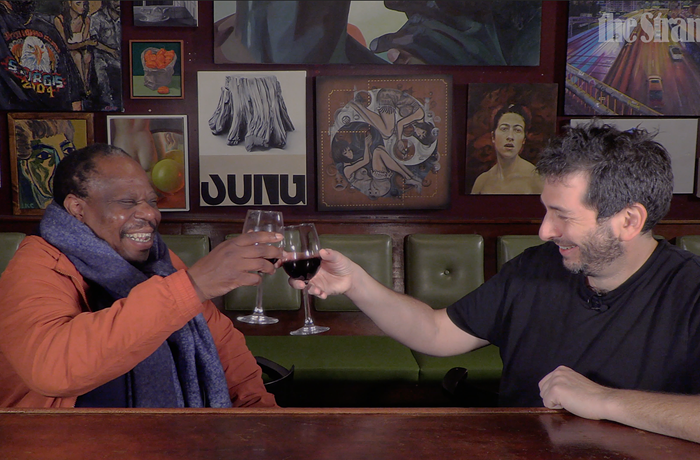
This was in a room on the second floor of Kane Hall, a high-ceilinged space with old-fashioned cluster lights and a huge organ at one end and a long banquet table down the center, piled with flatbreads and shrimp and tiny cakes. There was also a bar, serving complimentary wine. It had already been such a treat to see an hour-long free reading by the very wonderful Kay Ryan, who'd been introduced by the very wonderful Heather McHugh, that then to step into a room piled with free treats was, well, quite the treatment. Thanks, University of Washington Department of English!
"Thank you for that ridiculous introduction," Kay Ryan whispered to Heather McHugh as they walked into the reception. McHugh's introduction had been so dense with humor—poetry jokes and history jokes and many other kinds of jokes besides, plus some real-deal appreciation of Ryan's gifts—that Ryan's head, a few rows ahead of me, had been bobbing with laughter. And then Ryan got up and was very funny herself, so funny that afterward I felt exactly like that lady I overheard at the reception: I hope that I got some of the jokes. I love how intimidated that statement is.
"You cannot believe the eminences" the UW has invited to give the memorial Roethke reading since the 1960s, McHugh had pointed out onstage, and then looking at the list, she cracked: "They made one or two mistakes." Among the greats: Robert Lowell, Elizabeth Bishop, James Merrill. Ghost dinosaurs all, it occurred to me later.
Zeljka Marosevic at Melville House tells us about a meeting yesterday that was held to discuss Amazon.com's taxes, or lack thereof:
“What people will find particularly galling is that the amount Amazon is paying in tax is actually less than they are taking from UK taxpayers in the form of government grants. Companies like Amazon should pay their fair share of tax based on their economic activity in this country and the profits they make here...
Why is it people get ridiculously upset when someone on the internet sees a young mother of three buying some mildly unhealthy food with food stamps, but when Amazon sucks at the welfare teat on an exponentially larger scale, it's at best considered to be the free hand of the market and at worst just shrugged off as the way it is nowadays?
A year or so ago, Kay Ryan went to Italy, and it made her think about the sometimes-painful, always-disorienting work the mind has to do when it arrives in a new place. Last night at Kane Hall, she read to us a poem that described this problem of being somewhere new, but not knowing how to be new yourself, as if you had put up an “interior tent,” only to find that “the new holes aren't where the windows went.” The poem settled as she leaned into the podium. “I bet you'd like me to read that again,” she said, and the audience fairly moaned yes. Yes, Kay Ryan, read it again. The sheer delight Ryan took from examining her own work—as though it were not her own but the work of some dear, deranged friend—gave the reading a wondrously funny edge, and allowed the audience to see Ryan not as the intimidating literary giant that she is, but as a warm, comic entertainer of the highest sort, able to humble herself through a kind of soft, conscious mocking. (After the first poem of the night, she mused, “I find that a very touching poem, but I'm ready to go on.”)
She began the evening with a set of new, unpublished work on subjects including but not limited to W.G. Sebald, frogs with dual pupils, octopuses, Thelonious Monk, and 17th-century Dutch still-life painting. Much of it she flatly insisted on reading twice, claiming that “if it's a poem, it should bear a second reading,” when in truth Ryan's poems not only bear a second reading, but seem to require it – so dense and rich with these double meanings you could feel the audience leaning in and curling around them, straining to catch every word and every space between words before the moment passed. (More than once I looked around and saw the people on either side of me listening with closed eyes.) Sometimes the second reading seemed to be as much for Ryan herself as for us, and the second reading would inevitably give a second meaning. This twinned reality—what Ryan calls “doubleness”—was the predominant theme of the evening, much moreso than the Northwest theme Ryan half-heartedly attempted, but (gloriously) abandoned. One new poem in particular, a beautifully creepy thing entitled “Ship in a Bottle,” possessed this doubleness in spades. Ryan introduced it by saying that the poem is still a mystery even to her. (Not being able to see the poem on paper, I‘ve inserted line breaks where I sense them, sacrilegious as that feels):
It seems impossible
Not just a ship in a bottle
But wind and sea
The ship starts to struggle
An emergency of the two realized
We realized
We can get it out but not
Without spilling its world
A hammer tap and they're free.
Which death will it be,
Little sailors?
“I'll read it again. It's a mystery to me,” she repeated. “I mean, it all makes sense, but I'm not sure what it's getting at.”
(Travis Nichols reads at Elliott Bay Book Company on Sunday, May 19 at 3pm. It's free.)

Sure, sometimes a negative comment hooks into the meaty part of you. But it's not like the readership changed, that an imaginary army of cheering, adoring fans disappeared when the comment threads were installed, only to be replaced by a cantankerous mob of cretins. Now you get to instantaneously see how a small-but-vocal portion of your readers reacts to your work. Readers didn't have any unchallenged platform at all before, and now they do. Isn't that, on balance, really kind of cool?
When novelist and poet Travis Nichols worked for the Poetry Foundation, one of his jobs was to oversee a project in which comments were allowed on poetryfoundation.org. Perhaps the foundation expected an Athenian discourse about the nature of poetry and art in the digital age. And I'm sure the comment threads inspired some of that. But they also fomented a slew of bullies, off-topic comments, conspiracy theories, ax-grinding, and treatises on the sad state of American poetry. In an interview with Paul Killebrew, Nichols admitted that the negative comments made him feel "deeply, deeply bonkers for a few months, largely because I took a lot of the rote online bullying personally." The comment section was soon scrapped entirely, which caused several angry commenters to create their own sites accusing Nichols of fascism.
And now, finally, Nichols gets his revenge, in The More You Ignore Me, a novel in the form of one ridiculously long blog comment posted by our narrator, known only as linksys181...
The filmmakers of Atlas Shrugged Part III want to know, so they've opened up an online survey.
Tonight: If you're not going to see Kay Ryan tonight, you have a few other attractive readings options. First, Gary Greenberg is at Town Hall reading from The Book of Woe: The Making of DSM and the Unmaking of Psychiatry, which is a look at a book that has done a whole lot of damage to a whole lot of people in the last century. Second, Claire Messud reads The Woman Upstairs, which is a novel described as a "tour de force." Considering this is the very good Messud, that's saying something.
And there's another event tonight at a non-traditional reading venue, too. Hollow Earth Radio’s Furnace Reading Series is a quarterly performance of adventurous literature, using music and other sound effects to enhance the experience. The latest performer, Kathlene Postma, is editor of the Silk Road Literary Journal. She’ll be performing a new short story titled “Fetch” with some sort of aural accompaniment, which should make this a unique performance experience.

Sunday: Travis Nichols reads at Elliott Bay Book Company at 3 in the afternoon. The More You Ignore Me is a novel narrated by a comment-thread troll. You can find my review of it over in the book section this week, but the short version is that it's a well-written book about a very modern situation, and it's well worth your time. And Ilina Sen is at Town Hall at 5:30 pm. Sen is a "feminist scholar, human-rights activist, and author" who is globally admired. Here's an excerpt from her book, and here are links to all the Democracy Now! shows featuring her commentary. It should be a great cap on a great weekend.
There's plenty of other stuff, going on, too. Visit the full readings calendar for all the details.
Electric Literature's blog The Outlet brings this to our attention:
“Using ‘wicked’ as a term of approval” was first recorded in Fitzgerald’s 1920 novel This Side of Paradise, said Churchwell. And the act of partying (as a verb) was first used by E. E. Cummings in a 1920 letter describing how he’d “partied” in Paris.
Which means in a roundabout way, we have Cummings to thank for Rebecca Black's "Friday." That's the kind of thing that'll break your brain if you think about it too much.
Posted by news intern Ansel Herz
Last night at Benaroya Hall, author Michael Pollan paced the stage and talked to an audience that seemed to adore him. He's tall, thin, and bald with wireframe glasses. He wore jeans and a navy-blue sport coat.
If he'd been wearing a turtleneck, Pollan could have been mistaken for Steve Jobs. Which is appropriate, because his critique of the food system is Jobsian—highly effective, technically on point, even cool. But snobbish and alienating.
The substance of Pollan's argument against the corporate food industry is solid. He began with an anecdote from early in his career that encapsulates it perfectly, when he visited an Idaho farm where potatoes have to off-gas the toxicity from pesticides for five days before they can be turned into McDonald's French fries.
So I was totally with him. But then Pollan received the biggest laughs and applause of the night when he called the microwave "the Ayn Rand of appliances." He recounted the experience of buying frozen meals from Safeway as if it was an adventure on an alien planet. Waiting for them to cook in the microwave was "soul-irradiating," he said. The food was gross.
Pollan juxtaposed this with his nostalgia for the family meal of yesteryear, when kids "learn to argue without screaming or fighting. They learn the art of conversation." Chicken kiev was his favorite dish made by mom each birthday. (Who eats chicken kiev on his birthday?)
For the affluent Benaroya audience, this seemed to be all well and good. Personally, my memories of the kitchen are less fond. In single-family households (mine was firmly middle class), kids take on a lot more cooking and cleaning duties. I remember being yelled at a lot. And I thought frozen King's Hawaiian Teriyaki Bowls and Marie Callender pot pies were absolutely delicious.
Publishing Perspectives explains the weird lengths to which a publisher has gone to produce an Italian edition of the new book by the author of the Da Vinci Code on the day of the book's global launch:
For nearly two months, 11 people were kept tucked away in an underground “bunker” near Milan, Italy, (actually a windowless high-security basement at the Milan headquarters of Mondadori, Italy’s largest publishing company, owned by Silvio Burlusconi) where they worked seven days a week until at least 8pm each night; all to translate Dan Brown’s new book, Inferno, into French, German, Spanish, Catalan, Italian, and Portuguese in preparation for its multi-nation simultaneous release on its publication date of May 14.
The “translators 11” worked from February through April 2012. They were forbidden from taking mobile phones into the “bunker.” They were guarded by armed security personnel. Their laptops were secured to their workstations, and they were only allowed access to the internet through one, supervised, communal computer. They were banned from taking any notebooks or papers out of the bunker, and had to turn in the manuscripts they were working on each evening. Minibuses took them to and from their hotel.
A good translation is a work of art. This doesn't sound like it could possibly be a good translation, although a mass-produced translation of a Dan Brown novel might be some kind of double-judo-flip back into the realm of art.

I want so much to go on a bike ride with Kay Ryan. We'd have pizza and then take my favorite route through the Arboretum, slalom between families of ducks and guys cruising in the bushes, and ride out to the middle of that abandoned tract of freeway people call the Bridge to Nowhere. We'd lean our bikes (I've read she favors a mountain bike) by the spot where swimmers leap 30 feet into root-beer-colored water, where someone spray-painted "jump, pussy" on the cement in pink letters. I'd open a bottle of whiskey and start our conversation with a few questions about bikes.
It was on a cross-country bike ride that Kay Ryan, then 30 years old, realized she was destined to be a writer. She had recently begun a PhD in literary criticism at UC Irvine, but as she once said in an interview, "I couldn't bear the idea of being a doctor of something I couldn't fix." On this cross-country ride, she simply asked herself whether she liked writing poetry, and the answer was yes. When she returned home, she began to write, drawing inspiration, at first, from Ripley's Believe It or Not! She was named United States poet laureate in 2008, and next week, on May 16, will deliver the 50th annual Theodore Roethke Memorial Poetry Reading at the University of Washington, in the Roethke Auditorium.
I like bikes that resemble Ryan's poems—compact, streamlined, with an appearance of mechanical simplicity that belies their power. She often makes seemingly obvious or straightforward statements that, in the context of the poems, become complex. Similarly, she can use the same line, or nearly the same line, twice in a poem in such a way that they mean completely different things each time. For instance, in her poem "Lime Light," the meaning of "lime light," at first synonymous with "spotlight," is complicated by the introduction of an actual bowl of limes. If this sounds too simple to work, consider the peanut butter and jelly sandwich, or the gin and tonic, and then of course read the poem.

Joan Didion will be making a Seattle Arts & Lectures appearance at Benaroya Hall on Wednesday, June 5, and if you don't already have tickets, you need to get on it. I will be there, in a tuxedo, introducing her and asking the questions, which is an honor, as I am the Biggest Joan Didion Fanboy in the Universe™, although it's an honor tinged with anxiety, as she has been asked so many questions before. And, of course, she's already revealed so much about herself in her work. So I'm just curious: If you had an opportunity to talk about anything in the world with her, what would you ask?
In which you find out what Jon Stewart would do if someone served him frosting on another man's dick.
Years working in a bookstore will teach you a lot about book covers and how people respond to them—not only can you often tell when a book's good cover is selling it better than it should've sold, your own brain gets so used to the different tropes, you feel like you know exactly what a book will be by looking at the cover, the old adage be damned. That's mostly just you trusting publishers to correctly aim their product at the right reader, and it doesn't matter how many times you learn your lesson that they can really fuck it up, your brain loves an image. And it's not just about genre—if book covers consistently whitewash their characters, or use obnoxiously gendered design, it does have an impact on who reads what and how we think about books.
Earlier this week, young adult author Maureen Johnson tweeted this:
I do wish I had a dime for every email I get that says, "Please put a non-girly cover on your book so I can read it. - signed, A Guy"
— maureenjohnson (@maureenjohnson) May 6, 2013
And it kicked off a crowdsourced experiment in response to the fact that, like a lot of books by and about girls and women, her books get hot pink cursive and hearts and sexy white girl torsos on their covers.
She called her challenge "the cover flip" and asked people on Twitter and Tumblr to redesign existing book covers for the opposite gender, and then collected the best examples here. Check 'em out, some of them are really perfect.
Paul wrote about a similar conversation in the sci-fi/fantasy world last year.

• The Hugo House's final Cheap Wine & Poetry before summer features poets Jason Whitmarsh, Anastacia Tolbert, Jared Leising, and Samar Abulhassan, along with an open mic and lots of wine for a buck a glass. This reading is free, too.
• Tonight at the central branch of the Library, it's "An Evening with Ursula K. Le Guin & Mariano Martin Rodriguez." Le Guin and Rodriguez "discuss translating Gheorghe Săsărman's Squaring the Circle: A Pseudotreatise of Urbogony." This sounds like a delightfully weird time, and Le Guin doesn't do many public appearances. Plus: It's also free!
• Eric Drexler is considered by many to be the founding father of nanotechnology. If you want to know more about tiny robots fucking with molecular structure, I'd advise you go to visit Town Hall tonight at 7:30 pm. This reading is $5, but it's totally worth it.
• On Friday, we have a working poet's discussion about work and being a poet at the Good Shepherd Center and a very good poetry reading at Open Books. On Saturday, there's a biographer of the man behind Ripley's Believe It or Not, a joint poetry reading at a gallery, and the celebration of a French pop art collection at Fantagraphics Bookstore & Gallery with a special musical guest. On Sunday, Evgeny Morozov reads a book about how we think the internet can save everything, but really it probably can't.
• And so much more! As in, there are probably a dozen events happening this weekend that I haven't mentioned in this post. Visit the readings calendar to see the full slate of what's coming up this weekend and to find more information about all the events I mentioned above.
Here's Neil Gaiman's 2012 speech at the University of the Arts:
And here's Neil Gaiman's 2012 speech at the University of the Arts:

One is a $12.99 book titled Make Good Art, with just shy of 3000 words spread over a few dozen brightly lit pages, designed by Chip Kidd. The other is a free video that you can watch as many times as you want. (University of the Arts also published the text of the speech on their site, and you can read that for free as many times as you want, too.) The book even has the URL of the video printed in the front of it.
So why would you pay for something you can read, or watch, for free? Well, Chip Kidd's design is always interesting; this almost reads like a pictureless comic book, with the words spread all over the page to illustrate the meaning of the text ("liberating" is soaring alone over the top of a page, like it's been launched from a cannon, for instance). And Gaiman has a lot of completist fans. But let's not pretend this book is about art: This is obviously a play for the lucrative graduation book market, the distracted aunts and uncles who pour into bookstores every May to buy copies of Oh, the Places You'll Go! by the bushelful to give to the young high school and college graduates in their lives. And I suppose that this is a fine book for that purpose, but really: If you know a kid who's graduating high school, I bet they'd be happier if you gave them a card with money in it, instead. The odds are, they'll get another copy of the book from someone else. There's some good advice for artists in Gaiman's speech (the bit for freelancers is especially helpful), but it's not good enough to warrant a physical copy of the book, when the speech is everywhere online.
Last night, Eric Eldon and Ingrid Lunden at TechCrunch reported:
Microsoft is offering to pay $1 billion to buy the digital assets of Nook Media LLC, the digital book and college book joint venture with Barnes & Noble and other investors, according to internal documents we’ve obtained. In this plan, Microsoft would redeem preferred units in Nook Media, which also includes a college book division, leaving it with the digital operation — e-books, as well as Nook e-readers and tablets.
The documents also reveal that Nook Media plans to discontinue its Android-based tablet business by the end of its 2014 fiscal year as it transitions to a model where Nook content is distributed through apps on “third-party partner” devices.
For a while now, Microsoft has been the only major tech player without its own e-book storefront. This looks like an attempt to buy into the market with an already-established brand. I'm not convinced that the Nook e-bookstore is worth a billion dollars, but this certainly would be the easiest way for Microsoft to play catch-up with Amazon, Apple, and Google.
Deadline Hollywood has a great piece up right now about how Marvel Comics' notoriously cheap business practices are running headlong into actors who feel they're worth more than they're getting for starring in Marvel's wildly profitable movies.
The issue going forward is how many of the Avengers stars and starlets are still bound by early agreements and longterm options which Marvel can continue to exploit individually. To counter, I’ve learned the Avengers cast are becoming united behind Robert Downey Jr who is seen as the “leader” – like “a big brother” in the words of one rep - for all the younger actors in the ensemble. “He’s the only guy with real power in this situation. and balls of steel, too. He’s already sent a message that he’s not going to work for a place where they treat his colleagues like shit,” one source explains. Another rep tells me, “I have four words for Marvel – ‘Fuck you, call Robert.’” As Downey himself has said publicly about his $50M-plus payday, ”I’m what’s known as a strategic cost,” adding that Marvel is “so pissed” he earned that much.
It's funny—this almost exactly mirrors the way that Marvel has mistreated comics creators for decades now. (Read Sean Howe's excellent Marvel Comics: The Untold Story for more information about the history of Marvel's shameful history with artists and writers.) But unlike comics, where Marvel successfully bet that fans wouldn't care who was drawing Iron Man as long as Iron Man comics came out every month, I don't think an Iron Man 4 starring, say, Joel Edgerton as Tony Stark will be breaking any box office records, although it might still be a profitable movie. Could you imagine an Avengers 2 with an almost-entirely new cast? This issue, rather than superhero fatigue, might wind up being the thing that upends the Marvel Comics movie universe.
And I'm going to ask Ari questions about what it was like to fly all over the country on Mitt Romney's campaign plane and if the rumors about the Romney boys are true and why there are no pictures of Ari in leather on his Instagram account. And you're invited...

Since this event is taking place the weekend of Pride—the night before the parade—Ari has agreed to interview me while wearing nothing but a lime green thong. More info at Town Hall's website. Tickets available through StrangerTickets.
A Romney adviser's tell-all about what went wrong with the Romney campaign is being published next week, according to the Boston Globe.
The book – “A Bad Day on the Romney Campaign: An Insider’s Account” – is written by Gabriel Schoenfeld, who says he was a senior adviser to Romney from December 2010 through November 2012.
“The book illuminates the chain of errors that ultimately contributed to Romney’s defeat,” reads a summary of the 66-page book, which is being published next Tuesday as a $2.99 e-book by the Penguin Group.
By my count, this is the second book to perform an autopsy on the 2012 election. The first, Politico's The End of the Line, was published disgustingly quickly after the election and included a few notable bits of trivia. The account that everyone's waiting for, Mark Halperin's Double Down: Game Change 2012, is still scheduled for fall of this year. I hope there's some juicy stuff in there, but I honestly think the 47% tape will probably be the most scandalous thing to come out of the 2012 election; on a personal level, both Romney and Obama are pretty un-dramatic people who tend to accumulate boring people for their teams.
But still, I'll definitely be reading this one. I can't wait to see what Schoenfeld says is the reason for Romney's failure. I'm betting the most obvious fact—that Mitt Romney is totally unlikable—won't be in the book.
Because the weather is nice outside and you're feeling good about the world, here's a bit of depressing news to give you perspective: Harper Lee is suing to regain the copyright of To Kill a Mockingbird from her literary agent:
The lawsuit alleges that Samuel Pinkus, the son-in-law of Eugene Winick, who represented Lee for over four decades, took advantage of the 87 year old author’s declining health five years ago, when he “duped” her into signing documents she did not understand.
I'm trying to imagine something lower than taking advantage of Harper Lee's infirmity and I can't. Pantsing Judy Blume comes in a close second.
I got an e-mail this morning detailing the perfect Mother's Day gift for mothers who also happen to be total assholes:
Make May 12th An Atlas Shrugged Mother's Day
For one week only, take 10% off of the Official Women's "Atlas" Pendant & Necklace or, the Official Rearden Steel Dagny Taggart Bracelet. This Mother's Day, give the perfect gift to the woman who first inspired you.
Karen Green was married to David Foster Wallace, and she's the one who discovered his body after he committed suicide. As Nelson writes in the Los Angeles Review of Books:
The tender things may be painful for Green to remember; due to her crystalline, sincere rendering, they are also painful to read about. Perhaps because this is not the memoir of a couple married for decades — Green and Wallace had been married for but four years at the time of his death — the love here conveyed feels hot, blooming, then disastrously cut short, tragically adumbrated by all the trauma and anger that constitute suicide’s ugly gifts.
In addition to Free Comic Book Day tomorrow, there are a couple things you should know about this weekend:

2. On Sunday afternoon at Town Hall, local actors Paul Morgan Stetler and Stranger Genius Marya Sea Kaminski will read some of Willa Cather's letters aloud. This sounds like a great idea. Then, on Sunday evening at Town Hall, Joshua E. S. Phillips, who wrote a book called None of Us Were Like This Before: American Soldiers and Torture, appears in discussion with Ian Fishback, the soldier who sent a letter to John McCain in 2005 that launched the public discussion about torture. The two of them will talk about how torture became normal, discuss the reasons that torture happens, and try to understand what torture does to us all.
3. There are quite a few other events going on all weekend long. Visit our readings calendar for the full rundown.

1. Tomorrow is Free Comic Book Day! Those are always a lot of fun. If you don't know the routine: You can stop by any participating comic book store (Seattle has quite a few of them) and pick up some comics, for the low cost of absolutely nothing. And tomorrow's free comic book day is a special one, because Seattle's newest comic book store will be opening for business on Capitol Hill for the very first time at 10 am. Yesterday, I stopped by Phoenix Comics for a quick chat with owner Nick Nazar. The space, located right next to Dick's on Broadway, is going to need a lot of work to be ready to open tomorrow morning, but it's starting to come together; there's a new coat of paint on the walls and the carpet was just about set when I visited. The back room is stuffed full of boxes of board games, role playing games, and dice.
Nazar says that a big shipment of comics were delayed and won't be in the store by the time the store opens, but all the Free Comic Book Day titles are already onhand. The space, which Nazar says will be about 50% games and 50% comics (including monthly comics and trade paperbacks from all the major comics publishers and some local presses, too), will also have some comfy seating and tables in the back for people to try out games. Phoenix Comics will be open from 11am to midnight Mondays through Fridays, and 10 am to 9 pm on Saturdays. Nazar says the store will be closed on Sundays "for now." It's a tough business climate for comics shops, but Nazar has a great location and experience with these kinds of operations; he worked for Texas comics chain Dragon's Lair for years before moving to Seattle. Nazar is working on the Phoenix Comics website—after a year of planning, the location came together so quickly that the last two weeks have been a blur of activity—but for now Twitter is the best way to keep in touch with the store.
2. And after you've visited a few local comics shops, you should stop by Fantagraphics Bookstore and Gallery tomorrow night, where young comics sensation Dash Shaw will be showing a short film and debuting his brand-new book, New School. I just got a copy of New School in the mail the other day, and it's a big, beautiful book; certainly Shaw's most ambitious work yet. (I haven't been able to sit down and give it the time it deserves yet—it's dense like a novel, and not the sort of comic you can plow through in an afternoon.) It should be a great cap on a beautiful Free Comic Book Day.
Six years is a cruelly long time to go with nothing to read except the Bible and Danielle Steel. But that's exactly how long inmates at King County Correctional Facility have gone without essential reading materials—funding for the jail's library was cut in 2007. These days, the inmates hang their hopes on a lonely book cart pushed around on no discernible schedule, but even the cart is fleeting and irregular: Sometimes it comes, sometimes it doesn't. Sometimes the book you want is there; more often, it isn't. And if you do get your hands on a book, chances are good it will slip away. Books have a way of disappearing.
The Golf Pencil Group, named for the maddeningly dull pencils permitted in the jail, is a coalition of volunteer teachers and tutors who advocate for prisoners' educational rights: the right to writing, reading, and learning materials; to creative and educational support; and, perhaps most importantly, the right to a few hours spent each week in the safe, forgiving space of a classroom. Last week, the group held a fundraiser at the Black Coffee Co-op on Capitol Hill to raise money for classroom books and other much-needed services. (Dictionaries. Dostoyevsky. Decent reading glasses.) Slam poet Michael Hood and local poet Jay Thompson have been teaching a creative-writing class at the jail for the past 18 months, and they read poems written by their students...
Looks like some ex-Boston Phoenix staffers have been busy: This week, they launched the first issue of The Media, an ad-free, online-only alternative weekly. The layout is pretty old-school, which makes it feel kind of refreshingly new-school. You should read The Media's manifesto, which is titled "Fvck the Media." Like all good manifestoes, it's made up of some exciting stuff:
When I began to consider maybe starting something new, I thought hard about the specific voids left by the decline of alt-weekly journalism as well as pre-existing online publications. Some feel that the role of alt-weeklies is now carried out by blogs, but it's not. There is a specific rhythm to putting out a weekly, a thoughtful pace that the speed of the Internet diminishes.
It was a great privilege to be a part of the last generation working in the newsroom of one of the country's best alt weeklies. There was something special about how the Phoenix connected the dots between arts and music and alternative perspectives on news, politics, and activism. Recently on her Tumblr, Claire Boucher a/k/a Grimes wrote what many called a "feminist manifesto" (though it was more a personal essay about resisting oppressive behavior that is often normalized in music). "I don't want to have to compromise my morals in order to make a living," she wrote, and many of her words resonate in media just as much as music. But what really struck me came eight grafs down: "I'm sad that it's uncool or offensive to talk about environmental or human rights issues."
In the music world it's too often deemed cliché, naïve, idealistic, or straight-up uncool to talk about politics, news, activism, or environmental and human rights issues. The Phoenix was a breath of fresh air from that; a place that approached music and film with the same sort of critical contextualization it did news and politics. The alternative media world is lacking new publications like this, where folks can go for the experimental music coverage and stay for pieces on the climate crisis and feminism and weed and Occupy. This is the sort of publication I hope The Media will be.
This is exciting stuff. I wish them well, and I'll be keeping a close eye on how the experiment progresses. You can follow The Media on Twitter.
(Via Altweeklies.com.)
Jason Boog at Galleycat reports:
GalleyCat has learned that Granta will close its office in New York City.
We have also heard that deputy editor Ellah Allfrey and art director Michael Salu have both resigned. Associate editor Patrick Ryan will also be leaving.
This news comes one week after the news that Granta editor John Freeman is leaving. This is a sad state of affairs for one of the most prestigious literary magazines in the English-speaking world.
Prisoners are never free to go, even when they have been given release orders years ago, even when they are starving themselves to death.
But they are free to read Standup Paddling magazine and play Angry Birds.
Here's New York Times reporter Charlie Savage's blog entirely devoted to the library at Guantanamo.

As you read on Slog yesterday, tonight's special guests are artist Amanda Manitach and Stranger photographer Kelly O. Kelly O just showed me what she'll be reading: Thee Psychick Bible, a manual about ritual, "practical magick," and the importance of doing things with meaning; and Pissing in the Snow, a 1972 collection of folktales from the Ozark mountains, including stories such as "The Half-Wit and the Eel" and "He Done It With a Bucket."
Amanda Manitach says she'll be reading a Gideon's Bible she picked up at a motel in Northern California on a road trip over Christmas, as well as Justine by the Marquis de Sade.
Two other past reading party special guests crossed my path today—the musician John Roderick and the entrepreneur Linda Derschang—and both of them mentioned they'll be at tonight's reading party too. (After all, it's the last one until September.) So I asked them what they'll be bringing to read. Roderick will be reading Nora Ephron's I Feel Bad About My Neck, and Derschang will be reading James Salter's latest, All That Is.
Nice choice, Derschang. I'm jealous. Although I'm bringing along some Joan Didion, so I'm not that jealous. And you? What will you be reading?
As always: This happens in the Fireside Room at the Sorrento Hotel, 6 pm to 9 pm. There's live music from 6 pm to 8 pm, it's all ages, and it's free. If you have never heard of the reading party before, start here.