Slog

News & Arts

The Stranger Suggests

Critics' Best Bets
Music Arts & Food


Line Out

Music & the City
at Night

Tuesday, August 18, 2009

Still Shocking, After All These Years

Posted by on Tue, Aug 18, 2009 at 12:42 PM

Marcel Duchamp (American, born France, 1887-1968). Exterior: Etant donnes: 1 la chute deau, 2 le gaz declairage (Given: 1. The Waterfall, 2. The Illuminating Gas), 1946-66
  • © 2009 Artists Rights Society (ARS), New York/ADAGP, Paris/Estate of Marcel Duchamp
  • Marcel Duchamp (American, born France, 1887-1968). Exterior: Etant donnes: 1 la chute d'eau, 2 le gaz d'eclairage (Given: 1. The Waterfall, 2. The Illuminating Gas), 1946-66
Interior
  • 9. © 2009 Artists Rights Society (ARS), New York/ADAGP, Paris/Estate of Marcel Duchamp.
  • Interior
This summer is the 40th anniversary of the installation of Marcel Duchamp's final work, Etant Donnes, at the Philadelphia Museum of Art—one of the most enduringly strange experiences in art.


I first saw it in college, when I was more interested in the readymades. What was I thinking?

Etant Donnes is ten times more complex than the bicycle wheels and the bottle racks and the combs. I love it for a million reasons and hate it for a hundred. Both seem inevitable. Only one person at a time can look at Etant Donnes because it's seen through two peepholes in a big wooden door in a dark room off the main Duchamp gallery at the PMA (where it lives; it cannot travel). You put your eyes to the hole and find yourself staring down the barrel of a (headless) woman's exposed, bare, dark vaginal opening. The naked, overly white woman is lying in a mess of grass like the victim of a horrible crime; she's also holding up a lit gas lamp in her left arm, something like Lady Liberty. Stretching out behind her is an idyllic forest scene (a collage of painted photographs of a Swiss grotto) that is absolutely still except for a waterfall that sparkles sort of orangey-golden-pink like a bad opera prop. (The waterfall is made of dried transparent glue and has an illuminated rotating disc behind it powered by a hidden engine.)

Duchamp, Untitled (Erotic Object), 1959. Copper-electroplated plaster
  • © 2009 Artists Rights Society (ARS), New York/ADAGP, Paris/Estate of Marcel Duchamp
  • Duchamp, Untitled (Erotic Object), 1959. Copper-electroplated plaster
No wonder it's taken this long to do a comprehensive exhibition on the piece; people have been in a kind of glazed shock. But this summer's show at the PMA includes sketches, instructions, Polaroids of Duchamp leaning ominously over the naked plaster cast in his studio while working on the piece (he died the year before it came to the PMA), response works by other artists, and its web site is fat with images and information for anyone not going to Philly before November, when the show closes. (For those will be there, catch the Jeff Wall talk and symposium on September 11-12.) A 448-page catalog is out, and so is a reprint facsimile of Duchamp's manual, originally published by late PMA director (and Duchamp scholar) Anne d'Harnoncourt.


{{Break in informative text to LOOK AT THIS THIGH. (Duchamp's model was his lover before he married Teeny, the Brazilian sculptor Maria Martins. Side note: MoMA, this is unhelpful.)}}

Duchamp, Untitled (Left Leg), c. 1949.
  • © 2009 Artists Rights Society (ARS), New York/ADAGP, Paris/Estate of Marcel Duchamp
  • Duchamp, Untitled (Left Leg), c. 1949.

Most of Duchamp's more blatantly surrealistic sculptures, which are part of this exhibition, are more Arp/Brancusi than, say, Dali/Ernst. There's an artist in Seattle mining this territory today, occasionally creating something that grabs your gut, it's so beautiful and wrong.

Debra Baxters Untitled (neck crack), 2006
  • Debra Baxter's Untitled (neck crack), 2006

More images from the Duchamp show on the jump.

Click to enlarge.

Duchamp, Swiss Landscape with Waterfall (I), 1946. Gelatin silver print
  • © 2009 Artists Rights Society (ARS), New York/ADAGP, Paris/Estate of Marcel Duchamp
  • Duchamp, Swiss Landscape with Waterfall (I), 1946. Gelatin silver print

Duchamp, Landscape collage on plywood (study for landscape backdrop of Etant donnes), 1959.
  • © 2009 Artists Rights Society (ARS), New York/ADAGP, Paris/Estate of Marcel Duchamp
  • Duchamp, Landscape collage on plywood (study for landscape backdrop of Etant donnes), 1959.

Duchamp, Untitled (Erotic Object), c. 1950.
  • © 2009 Artists Rights Society (ARS), New York/ADAGP, Paris/Estate of Marcel Duchamp
  • Duchamp, Untitled (Erotic Object), c. 1950.

John D. Schiff (American, born Germany, 1907-1976), Marcel Duchamp (With Pipe), 1957
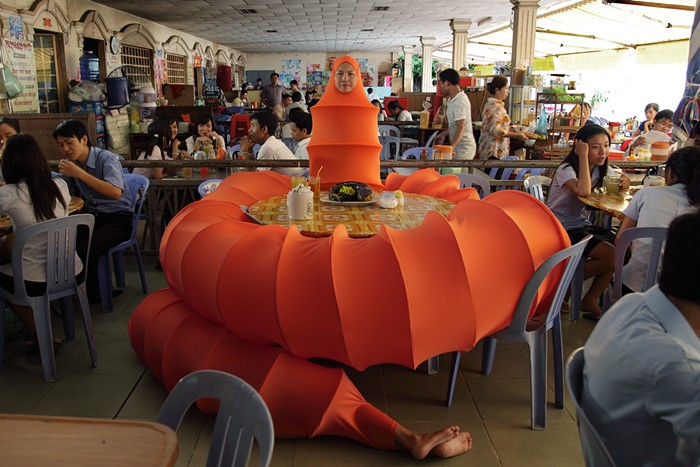
  • John D. Schiff (American, born Germany, 1907-1976), Marcel Duchamp (With Pipe), 1957

 

Comments (5) RSS

Oldest First Unregistered On Registered On Add a comment
1
Etant Donnes and The Bride Stripped Bare By Her Bachelors, Even were my favorites since the tender age of 15. I must have done at least three papers on the latter during undergrad, but never even attempted the former.

It's times like this that I actually (god forbid) miss being a Philadelphia resident. You ain't seen nothing 'til you've seen Etant Donnes in the flesh (as it were).
Posted by Maxine on August 18, 2009 at 1:23 PM
Gurldoggie 2
Great post Jen. Thanks.

You don't mention, though you probably know, that part of what is so shocking about the image is that it's not clear WHAT body part you're looking at. You think it should be a vagina, but the gash is weird and twisted, and not centered between the thighs. It could be a deformed pussy. It could be a stab wound. You have to keep looking at it, and it never quite makes sense. It's an incredibly nauseating experience.

Duchamp truly is the artist who keeps on giving. I don't think it's an exaggeration to say that all art since Duchamp has been a reaction to his body of work, which has never been equaled.
Posted by Gurldoggie http://gurldogg.blogspot.com on August 18, 2009 at 1:26 PM
3
I remember meeting the then-curator of the modern collection at the PMA, only to be regaled with tales of how many angry letters he receives from parents re: Etant Donnes. His solution? Place a step stool in front of it so that every child, regardless of height, is sure to get a good peek.
Posted by Maxine on August 18, 2009 at 1:36 PM
4
"I first saw it in college, when I was more interested in the readymades. What was I thinking?"

Is that, like, a threat? Like we're gonna have to hear you tell us?
Posted by Hateful today on August 18, 2009 at 2:40 PM
translinguistic other 5
Thanks for posting this. I don't know how I'll make it to Philly before November, but this has always been a favorite of mine as well. I missed it the first time I was there (it's sort of out of the way and off to the side and I didn't know what it was) and returned years later specifically to see it.

@1, I also wrote several papers about this piece and The Bride Stripped Bare in college. One interesting point (made by Juan Antonio Ramirez, perhaps?) is that the space occupied by both works is analogous. That is, the door of Etant Donnes is the horizontal barrier between the Region of the Bride and the Region of the Bachelors. Which puts you the viewer in the position of the bachelors, desperately desiring to penetrate the mystery of the bride but getting nothing back except whatever it is you've shot off at her.

SOOOOO GOOD.
Posted by translinguistic other on August 18, 2009 at 4:42 PM

Add a comment

Advertisement
 

Want great deals and a chance to win tickets to the best shows in Seattle? Join The Stranger Presents email list!


All contents © Index Newspapers, LLC
1535 11th Ave (Third Floor), Seattle, WA 98122
Contact Info | Privacy Policy | Terms of Use | Takedown Policy