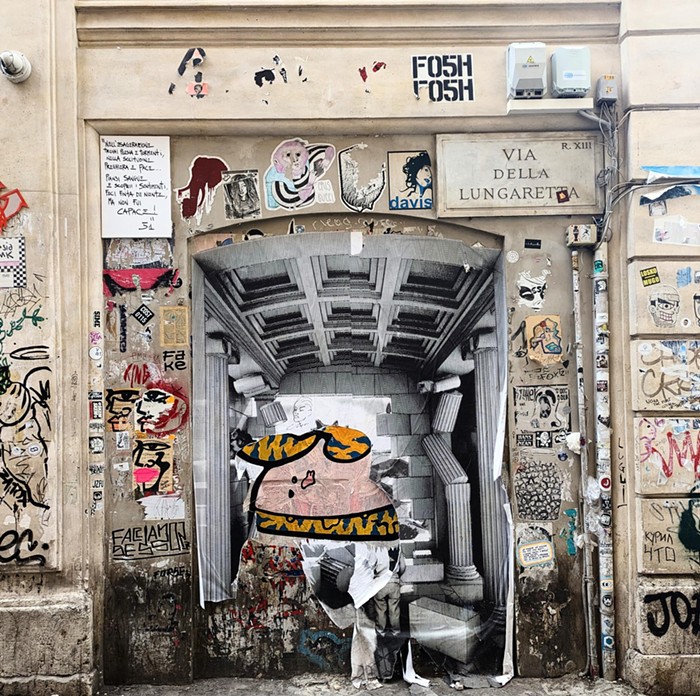
It happened to me after a death, so maybe it doesn't count. I just mean: I was in a tearful state of mind anyway. But honestly, when I found myself crying in front of this artwork, it didn't feel like I was grieving. It felt like a different cry than I'd been having, like a relief from that other crying. Here's what happened: I went into the Henry Art Gallery, walked down the stairs into the underground gallery, approached the artwork pictured (Footings by Lead Pencil Studio) and when I got close to it, it reached out and touched me. It must have been something to do with the electricity; to me it was electrifying, and I started to cry.
 When I think back on it, I think the reason I cried is that the plastic was so soft and silent in its reaching out. It was formed in the shape of the hard, solid concrete footing for the George Washington statue outside this gallery, and the way it was suspended in midair in this underground space, it was like these old hard footings had been buried in dirt and were now seen in X-ray or something. When it reached out to touch me it seemed to be saying that being buried in the earth is soft, not hard; a release, not a confinement. Or maybe that's being too literal. I don't know exactly why I cried, to tell you the truth. I saw a lot of art around that time, and this was the only piece that affected me this way.
The reason I'm telling you this is that I've started reading a book I want to recommend: James Elkins's 2001 Pictures & Tears, the premise of which is: When do we cry at art, and why? To do his research, he solicited personal responses to this question from all sorts of people, and got an outpouring of more than 400 letters. Some were from stoic art historians who declared themselves above or apart from such a thing as crying. He writes about that, too. (Turns out Rothko is the modern artist who causes the most crying, but "James Breslin doesn't discuss crying in his entire six-hundred-page biography [of Rothko], but he says the original impetus for his book was his own experience crying in front of a Rothko painting shortly after his father died"). Another example of the stigma of crying from the letters section at the back of the book:
Letter 8
From a famous, tearless, and unrepentant art historian.Dear James Elkins,
Your next project on the Niobe syndrome (art historians moved to tears by what they are seeing) sounds most engaging; and I am intrigued to learn that the response to your questionnaire has been "overwhelming." For myself, I would rather not participate, even at the risk of confessing to a stony, unfeeling nature.With warm regards,
Professor Gusztáv L.
Most of the letters are from people like me, who cried at art one time or another, and aren't entirely sure what happened there. Elkins is always fun to read (he's the author of the classic Why Art Cannot Be Taught: A Handbook for Art Students), and he goes back into history and across disciplines, from the poets to the philosophers to the Romantics and Renaissancers to his own very direct experiences with the artworks his letter-writers report caused them to cry. Each crying is a little mystery he wants to solve.
The chapters of the book are: "Crying at nothing but colors," "Crying no one can understand," "Crying from chromatic waves," "Crying because you've been hit by a lightning bolt," "Weeping over bluish leaves," "The ivory tower of tearlessness," "False tears over a dead bird," "Crying because time passes," "Weeping, watching the Madonna weep," "Crying at God," "Sobbing in lonely mountains," and "Crying at the empty sea of faith," with an addendum, "How to look and possibly even be moved."
The book is in the library or here at Powell's.