Slog

News & Arts

The Stranger Suggests

Critics' Best Bets
Music Arts & Food


Line Out

Music & the City
at Night

Wednesday, May 13, 2009

A Call for Actual Common Sense, Not the Folksy Kind

Posted by on Wed, May 13, 2009 at 2:00 PM

bf32/1242248283-dr392d17.jpgA few minutes ago I went on KUOW to talk to Ross Reynolds on "The Conversation," about public art. The subject for today was the editorial in this morning's Seattle Times by state Sen. Steve Hobbs (D-Lake Stevens)—in which Hobbs decrees art to be the enemy of teachers, the sick, and the poor.

If we could just cancel public art for the next two years, he writes, we could save our state. Why, oh why, is art so damned selfish?

"I'm mad as hell, and I'm not gonna take it anymore!" Hobbs veritably yells in his editorial.

Then, on the radio, he declared public art a "luxury" and a "sacred cow." He said he didn't want to kill it, he just wanted to do some "cowtipping."

Hobbs has the right idea: The legislation he proposed is as intelligent as cowtipping.

Does any of this sound familiar? It's exactly the same debate we were having when the National Endowment for the Arts had to get on its knees and beg to be included, for the miniscule price tag of $50 million in the $787 billion federal bailout.

It's also the same debate we've been having since Jesse Helms made it obvious that art, due to its subjective nature, would be the easiest target for public ire—the easiest way for politicians to distract the public from real problems.

PUBLIC ART FUNDING IS A RED HERRING, PEOPLE. If we'd fined every politician who tried to use public art for his or her own gain in the last 20 years (thanks, Patty!), we could have paid for art/music/dance/etc teachers in public schools this whole time. Imagine!

The state spends about $2 million a year on public art, in an approximately $15 billion operating budget. Public art spending accounts for .013 percent of the state's budget.

Please ask your legislators to focus their time and money on fixing the other 99.987 percent of the budget. Please ask your newspapers and broadcasters (as much as they can) to disallow idiotic, ancient, false debates.

I'm sorry to be belligerent about this, but it is infuriating to have this dumb conversation year after year after year, whether the economy is up or down or in-between, and whether the politicians are Democrats, Republicans, or space invaders.

Most important of all for every intelligent person out there: Don't let anybody, ever, say that art is preventing Americans from being educated, fed, and cared for.

We're mad as hell, and we're not going to take it anymore.

UPDATE: One more thing: On the radio, Ross Reynolds was also interviewing Washington State Arts Commission executive director Kris Tucker, whose office oversees public art in the state. Tucker talked soft, about "quality of life" and making our buildings "better." Tucker basically refused to engage.

Blech. Why didn't you call him on his shit, Kris? And where were your numbers?

Kris, I realize that you and your office have to spend most of your time convincing legislators about your point of view, and maybe very different things need to be said in those private meetings, but this was a public forum, and you should have creamed him—or sent someone who could.
 

Comments (29) RSS

Oldest First Unregistered On Registered On Add a comment
1
My dad, who grew up on an Angus cattle ranch, says you can't actually tip a cow: They wake up, get pissed off, and walk away.
Posted by Bethany Jean Clement on May 13, 2009 at 2:10 PM
Cato the Younger Younger 2
I really don't care. I mean that is America; you're worried about art?!? Hell, a DEMOCRAT in the US Senate had people arrested and hauled out of the committee room for suggesting that we should even debate, just debate, single payer healthcare.

Trust me, sit back and enjoy the collapse of America. Obama can't/won't stop it; he'll just slow it down a little bit.
Posted by Cato the Younger Younger on May 13, 2009 at 2:11 PM
3
Oh please. Some people don't want anything that makes life more enjoyable.
Posted by Aqua Regia on May 13, 2009 at 2:17 PM
4
A modest proposal: tax those with incomes above some given high amount and put that money to use to buy art. In other words restore the patronage that used be part of the noblesse oblige but which has waned with the decadence of our corporate mores.
Posted by kinaidos on May 13, 2009 at 2:18 PM
Tina 5
@1; You aren't "tipping" them hard enough...
Posted by Tina on May 13, 2009 at 2:27 PM
treacle 6
Anyone have any red herrings with the words "Public Art" we can send to state Sen. Steve Hobbs (D-Lake Stevens)?
Posted by treacle on May 13, 2009 at 2:33 PM
treacle 7
@2. Did you hear that 5 US Representatives were arrested outside the Sudanese Embassy protesting the issues in Darfur?
Posted by treacle on May 13, 2009 at 2:37 PM
8
It is also worth noting that it was here in Washington State the the idea of 2% for public art was started.
Posted by moomim on May 13, 2009 at 2:52 PM
Will in Seattle 9
Don't you mess wit my culture n heritage!

4-H represent!
Posted by Will in Seattle http://www.facebook.com/WillSeattle on May 13, 2009 at 3:05 PM
Will in Seattle 10
@5 is right - this is why you usually get about 2 or 3 guys - the problem is you start snickering and wake the cow up.
Posted by Will in Seattle http://www.facebook.com/WillSeattle on May 13, 2009 at 3:07 PM
COMTE 11
Actually, it IS possible to tip a cow, but it involves a chain-saw and can get really messy.
Posted by COMTE http://www.chriscomte.com on May 13, 2009 at 3:17 PM
12
I find it ironic that this legislator doesn't seem to understand that artists are no less deserving of making a living than teachers, brick layers, or my heavens-legislators. Not that one can make a living from the public art "lottery" of WSAC--though it can help contribute to the bottom line. The work is made for the benefit of the public, consequently, his proposal to limit competition to Washington-state based artists is both protectionist and antithetical to the overall purpose. Further, artists cross state lines to make work. This would imply that other states should establish similar policies which wouldn't benefit the state OR artists.
Posted by Tes on May 13, 2009 at 3:21 PM
MadDog 13
Back to the real issue, cow tippers, yeah Jen! We with such little pieces of the pie want to keep our crumbs...
Posted by MadDog on May 13, 2009 at 3:27 PM
14
It's "minuscule."
Posted by alwaysamasshole on May 13, 2009 at 3:36 PM
15
I listened to that KUOW program and I'm sorry but I'm with the State Senator.

Yes, $2 million dollars in a 15 billion dollar operating budget is a minuscule amount, but where I come from $2 million dollars is still a lot of money. According to Ms. Tucker this Arts program funds 46 public arts projects in our state, which employ 35 artists part time (and some unknown amount of fabricators and materials people either full/part time). This means that we have a state program that employs 35 people part time at a cost per person of $57,142. What do we get to for this money? Pretty building and an "increased quality of life." Well you know what would greatly increase my quality of life? Health Care. For that same amount of money we could provide 200 people quality health care and that is if we paid retail for it. Yes, 200 people is a small amount of people but if the options are "making the building pretty" or "helping a mom with her diabetes" I'm way more in favor of diabetes treatment.

Finally, the idea that we should use our tax money to buy local art gets laughed off as hopelessly naive, yet at the same time we should only shop at local shops, buy local coffee, and buy our produce locally. So buying books, coffee, and fruit locally good, but our Art we have to import from New York?
Posted by jackofgreen on May 13, 2009 at 3:43 PM
Will in Seattle 16
Now, sheep tipping, that's difficult. Plus if you raise em near a pond they get all mucky.
Posted by Will in Seattle http://www.facebook.com/WillSeattle on May 13, 2009 at 3:59 PM
Eric F 17
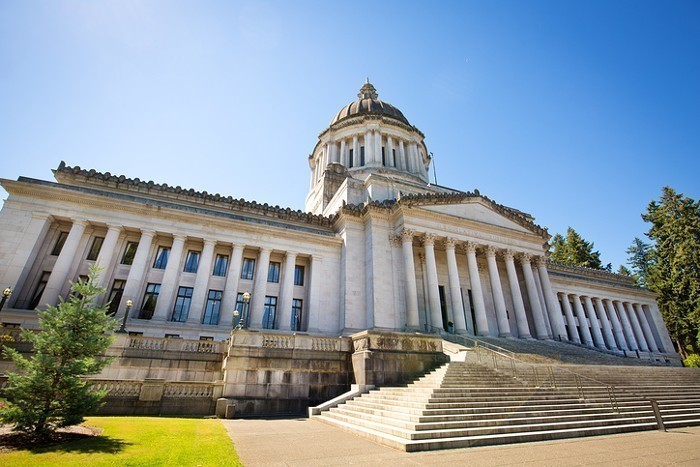
@15, Fine, let's build all our state and city buildings, starting with Olympia City Hall, from cinderblocks and tarp, and spend the savings on healthcare. You in?
Posted by Eric F on May 13, 2009 at 4:41 PM
Eric F 18
Longer @17: Combined with Dan Webb's recent gutting by the City of Olympia, this editorial is depressing. In both cases the attack is based on economics, with slurs about the work itself used only for decoration. (Calling Brian Tolle's knockout sculpture at UW a $286,000 tree stump, nice one!)
If the question is money, cutting a single percentage point (or more) from construction budgets could be done in any number of ways other than killing a popular program that's been going for decades. Jen nailed it: This is a bogus populist gesture, nothing more. But then you read the comments sections of the Times and the Olympian and wail.
Posted by Eric F on May 13, 2009 at 4:46 PM
merry 19
@ 17 - Tarp? Who needs tarp? Where I come from, that's just fancy-talk... Sod roofs were good enough for our ancestors, they should damn sure be good enough for bureaucrats....
Posted by merry on May 13, 2009 at 4:50 PM
20
How about redirecting that 2% for public art to go to art and music education for the public schools?
Posted by There's only so much art glass one can stand.... on May 13, 2009 at 8:04 PM
Will in Seattle 21
How about redirecting 2 percent of money for roads to go to say higher education.

Makes a lot more sense.
Posted by Will in Seattle http://www.facebook.com/WillSeattle on May 13, 2009 at 8:07 PM
joey veltkamp 22
I'm with 17...I know the arts are easy to pick on. But come one, it's like folks complaining about the ten jars of jam being wasted at Lawrimore Project for a collaborative project. Sure, we can always do more (all gallery space would serve the community better if it were turned into homeless shelters) but it surprises me that as a society we place such little value on art. It doesn't have to be a $100,000 sculpture, I love what Mandy Greer is doing with community. Does art really make folks that angry? I don't think Dan Webb's proposal was Piss Christ. It seemed like a real thoughtful, engaging piece of art and I can't imagine what got everyone so angry.

It seems like lately ("during these economic times") that art has become this maligned buzzword for fiscal irresponsibility. Without getting too dramatic, the lack of appreciation for art just seems like it has to be a portent of a civilization on its decline. What will it take for folks to start thinking art is a good thing again? I don't recall a similar uproar in 2006 when federal funds were used to help develop Olympic Sculpture Park (directly promoting public art). Is it an elitist pursuit that has less relevance once money's tight?
Posted by joey veltkamp http://www.72clouds.com on May 13, 2009 at 9:34 PM
23
15, 20, and 21 are all far better uses for that money.
Posted by Reader on May 13, 2009 at 11:13 PM
24
For those concerned with the numbers (@15) lets set aside the snide remarks about beauty and quality of life. the fiscal truth is that normally only 15-20% of the budget ends up in the artists pockets as income, more if they do the majority of the labor. the rest is spent. most often at local and locally owned businesses. many of them small and specialized. it is put back into the local economy helping employers keep employees on the payroll, pay for health insurance, and pay their taxes. those employees then continue to have money to buy goods, pay their taxes and stay off public assistance. get it? it is stimulus like any other.

It is not money that can be moved around. That half a percent would just stay in the construction budget and disappear. It can't be used for education or health benefits. It is not discretionary.
Posted by eley on May 14, 2009 at 12:52 AM
25
During the Helms-era complaints about the NEA, someone I knew took up the typical line.

"Look," I said, "the average taxpayer contributes about 64 cents to the NEA. I'll pay you a dollar to drop it."

And I got to keep my buck.
Posted by John D on May 14, 2009 at 1:13 AM
Greg 26
I have yet to hear a good argument against limiting state arts funding to artists in this state.
Posted by Greg on May 14, 2009 at 8:34 AM
27
I don't think I could have said it better than Joey (no.22) and he also brings up Mandy Greer, who's working on an awesome project which brings people closer to art.

Everyone takes the art they see around them for granted as part of the landscape; beautification as it were. But what if it were completely gone? How would we function in a completely utilitarian world? Not well, I'm guessing.

Every day I deal with the fundamental importance art has on our daily lives. I teach art to kids in an after school/weekend program and see the effect it has on their non-artistsic lives. Those afflicted with Asberger's and high-functioning autism, the mathematically inclined and artistically inclined alike are benefiting from the ways in which art enriches their experience outside the studio.

Public art functions in the same way. It brings art, dangerously elite on the walls of museums and galleries, into our every day lives and environments. By virtue of its presence, we are enriched by it. Aesthetics bring us pleasure. It betters our world. Not everything can or should be sharp angles, sheet glass curtains and concrete.

I don't even understand why this is a debate. War is a luxury. Art is not. Education and health care are important, but in our current gasping-for-air culture none of these things are mutually exclusive for our survival.

Where would you rather have your tax dollars going?
Posted by sharonArnold http://dimensionsvariable.org on May 14, 2009 at 10:12 AM
28
[p.s.] By the way, that public art fund is also keeping artists like Mandy Greer employed. In the "current state of our economy" isn't it as important for people from non-traditional industries to stay employed?
Posted by sharonArnold http://dimensionsvariable.org on May 14, 2009 at 10:15 AM
Sara E 29
Thanks for the article Jen.

I'm in strong agreement with the sentiments @12 @18 @24 @27.

The benefits of public art are multi-faceted. Art increases the livability, walkability and desirability of neighborhoods and cities, which in turn, drives local economy, tourism, health, safety and more resources for better quality of life. Public art projects = jobs for artists and jobs for others when they buy materials locally, work with local contractors and engineers and fabricators to assist with the execution of these projects. Many of these sentiments are nicely wrapped up in this recent Forbes article.
http://www.forbes.com/2009/05/05/state-o…
I'm particularly fond of the economic figures stated. An recent artwork costing the New York City $15.5 million, "brought in, according to the Public Art Fund, $69 million for the city."

As far as dealing with art in a recession, I think like with any other government or business program, the recession is a good time to assess the effectiveness of programs and seek efficiencies and improvements. But to advocate for sweeping cuts and freezes for effective programs that are economic stimulus drivers is a cowardly, narrow approach and will not help us turn the economy around.

Sara E
Posted by Sara E on May 14, 2009 at 11:31 AM

Add a comment

Advertisement
 

All contents © Index Newspapers, LLC
1535 11th Ave (Third Floor), Seattle, WA 98122
Contact Info | Privacy Policy | Terms of Use | Takedown Policy